BAA Ninth Bienniel International Romanesque Conference: Toulouse – Transmission, Reception and Imitation in Romanesque Art and Architecture, Toulouse, 13-17 Apr. 2026

Conference

BAA Ninth BIENNIEL International Romanesque Conference

Toulouse – Transmission, Reception and Imitation in Romanesque art and architecture

Hôtel d'Assézat, Toulouse, France

13-17 April 2026
The British Archaeological Association will hold the ninth in its series of biennial International Romanesque conferences in Toulouse from 13-17 April, 2026.

The British Archaeological Association will hold the ninth in its biennial International Romanesque conference series on 13-17 April 2026. The theme is Transmission, Reception and Imitation in Romanesque art and architecture, and the aim is to examine not only the ways in which techniques, iconographic motifs and styles moved around Romanesque Europe but also the ways and reasons they were adopted, and particularly how they were transformed in their new environment.  Some aspects of the question are well-researched: the movement of artists or masons, patronal activity and monastic affiliation are obvious examples, and perhaps in need of critical re-examination. Other factors, the pre-existing artistic  background, liturgical concerns, economic and social factors or transcultural exchanges will also have played a part. 

The conference will be held at the Hôtel d’Assézat in Toulouse from 13-15 April 2026 with the opportunity to stay on for two days of visits to Romanesque buildings in the surrounding area on 16-17 April. These will include visits to monuments and museums in Toulouse itself, and an excursion to Moissac. Booking forms and further information about  the conference will be sent out later in the year. 

Speakers include Dustin Aaron, Claude Andrault-Schmitt, Mañuel Castiñeiras, Kathleen Doyle, Cecily Hennessy,  Wilfried Keil, Nathalie Le Luel, Javier Martínez de Aguirre, Robert Maxwell, Luigi Carlo Schiavi, Béla Zsolt Szakács,  Elizabeth Valdez del Álamo, Rose Walker, and Michele Vescovi.

Conference Convenors: Quitterie Cazes and Richard Plant Conference Secretary: Kate Milburn. All enquiries about the conference should be sent to conferences@thebaa.org.

It would not be possible to mount this conference without John Osborn, and the British Archaeological Association wishes to take this opportunity to thank him for the boost to Romanesque scholarship afforded by his great generosity. 

For more information, visit https://thebaa.org/events/2026-romanesque-conference/

Exhibition Closing: EINE MORD(s) GESCHICHTE, Essener Domshatz, Essen, 08 Nov. 2025 - 29 Mar. 2026

Exhibition Closing

EINE MORD(s) GESCHICHTE

Essener Domshatz, Essen, Germany

08.11.2025 bis 29.03.2026

Vor 800 Jahren erschütterte der gewaltsame Tod des Kölner Erzbischofs Engelbert von Berg das gesamte Reich und die Region, die heute als Ruhrgebiet bekannt ist. Vermeintlicher Auslöser dieses Mordes war ein Streit um die Vogtei des Essener Frauenstifts, die zu diesem Zeitpunkt Engelberts Neffe, Friedrich von Isenberg, innehatte. Die Ausstellung EINE MORD(s) GESCHICHTE vom 08.11.2025 bis 29.03.2026 im Domschatz Essen beleuchtet die Ereignisse rund um Engelberts Tod.

Dabei rücken die Macht- und Besitzstrukturen des Essener Frauenstifts in den Fokus. Warum war ausgerechnet der Besitz dieser Institution von so großem Interesse für die umliegenden Herrscher und welche Mittel und Wege nutzten die Essener Stiftsfrauen, ihn zu wahren? War die Kontrolle über den Stiftsbesitz wirklich alleiniger Auslöser für die dramatischen Ereignisse des 7. November 1225? Und welche Spuren Engelberts lassen sich eigentlich nach so langer Zeit im Essener Domschatz noch entdecken?

Es geht auf eine spannende Reise in das frühe 13. Jahrhundert. Die Ausstellung zeigt selbstbewusste und machthungrige Akteur*innen, die in die Ereignisse rund um den Mord an Engelbert verstrickt waren und betrachten bekannte und unbekannte Objekte des Essener Domschatzes im Licht der dramatischen MORD(s) GESCHICHTE.

Die informationen: https://domschatz-essen.de/der-essener-domschatz/aktuelles-und-termine/details/eine-mords-geschichte

Upcoming Exhibition: Licornes!, Musée de Cluny, Paris, 10 Mar. 2026 - 12 July 2026

Upcoming Exhibition

Licornes!

Musée de Cluny, Paris

10 Mars 2026 - 12 Juillet 2026

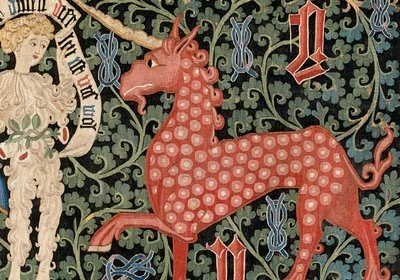
Connue depuis l’Antiquité, souvent mentionnée et représentée au Moyen Âge, la licorne est aujourd’hui encore une créature mythique qui suscite la fascination. Elle peuple la littérature fantastique comme les univers enfantins. Elle revêt des significations variées, évocatrices de singularité ou de succès, à l’exemple du terme licorne pour désigner une start-up florissante.

L’exposition invite petits et grands à explorer l'histoire fascinante de cette créature. Elle révèle la licorne non seulement comme un animal fantastique, mais aussi comme un symbole aux multiples résonances. Organisée en huit sections, elle étudie l'iconographie de la licorne dans une perspective historique, mais aussi intellectuelle et esthétique, et incite les visiteurs à des lectures multiples.

Une exposition du Museum Barberini, Potsdam et du musée de Cluny - musée national du Moyen Âge, Paris, en collaboration avec le GrandPalaisRmn.

Consultez la page dédiée à l'événement. 

Pour plus de détails, consultez https://www.musee-moyenage.fr/activites/programmation/licornes.html

Call for Papers, The Purple and the Book: Precious Manuscripts from Late Antiquity to Renaissance, Turin (18-20 Nov. 2026), Due by 28 Feb. 2026

Call for Papers

The Purple and the Book: Precious Manuscripts from Late Antiquity to Renaissance

Turin, 18-20 November 2026

Due by 28 February 2026

Purple manuscripts represent a distinctive genre in Western bookmaking production, holding significant artistic and cultural value. Known since Late Antiquity, the purple colour imparts a high symbolic worth: a mark of imperial authority, it later became, with the advent of Christianity, a symbol of the blood of Christ, of martyrs, and of the authority of the Church. After a revival during the Carolingian era, which influenced Ottonian and Romanesque illumination, these manuscripts experienced renewed prominence during the Humanist and Renaissance periods.

This international conference, as the concluding event of the PURple Parchment LEgacy project (PRIN 2020; https://purpleproject.it), brings together scholars from various fields, time periods, and traditions of book decoration. The aim of the meeting is to offer a comprehensive and multidisciplinary overview of purple manuscripts and the use of purple in manuscript decoration. In addition to invited keynote talks, there will be an open session dedicated to more focused themes and case studies.

Proposals are invited for papers (maximum 15 minutes) addressing, but not limited to, the following research areas, covering periods from Late Antiquity to the Renaissance:

  • case studies on single works or small groups of manuscripts, with a particular focus on their historical-artistic context

  • in-depth studies of techniques and materials (dyes, writing supports, bindings, etc.)

  • research on written sources that contribute to the reconstruction of historical-artistic, documentary, and technical aspects

  • the history of purple manuscripts, with attention to their provenance and collecting histories

Submissions from PhD students, postdoctoral researchers, and early-career scholars are especially encouraged, as well as presentations of ongoing research or projects.

Proposals should be submitted in a single document (Word or PDF format) by 28 February 2026 to: convegno.purple@unito.it. Submissions should include:

  • Full name, email address, and current affiliation

  • Paper title

  • Abstract (maximum 2,000 characters, including spaces)

  • Short CV (maximum 1,000 characters, including spaces)

Proposals may be submitted in Italian, French, English, or German, and will be reviewed by the organizing committee. The outcome of the selection process will be communicated by March 2026.

The conference will take place in person in Turin. Accommodation expenses will be covered by the organization (travel expenses will be the responsibility of the participants). The conference proceedings will be published following a peer-review process

Mary Jaharis Center for Byzantine Art and Culture Lecture: Spindle Whorls and Women’s Work: Reframing Middle Byzantine Lives in the Athenian Agora, Fotini Kondyli, 4 Mar. 2025, 12:00-1:30PM, Zoom

Mary Jaharis Center for Byzantine Art and Culture 2025-2026 Lecture Series

Spindle Whorls and Women’s Work: Reframing Middle Byzantine Lives in the Athenian Agora

Fotini Kondyli

University of Virginia

March 4, 2025 | 12:00–1:30 pm (Eastern Standard Time, UTC -5)| | Zoom

Middle Byzantine spindle whorls from the American School of Classical Studies’s Athenian Agora Excavations attached to cataloguing cards. Photo: Fotini Kondyli

The Mary Jaharis Center for Byzantine Art and Culture is pleased to announce the final lecture in our 2025–2026 lecture series.

Over 150 Middle Byzantine spindle whorls in bone and steatite have been uncovered in the Athenian Agora Excavations, found in domestic and work spaces as well as in burials. In this lecture, I move these objects out of the artifact catalogues where they often linger and let them speak, telling the stories of the women who used them and the non-elite lives they illuminate.

By tracing the “biographies” of these tools—their birth (materials, making, design), working life (use, skill, transmission), and economic movement (exchange, display, disposal)—we can reconstruct rhythms of women’s labor and situate spinning within the urban economy of Byzantine Athens. Highly decorated surfaces, combining polished planes with incised grooves and circles, reveal a tactile aesthetic meant to be felt as much as seen. These designs, often associated with sacred or protective motifs, suggest that spindle whorls were not merely functional but active participants in religious experience and domestic protection. Decoration also connects these objects to a wider world: parallels with Islamic spindle whorls from the 9th–10th-century point to cultural exchange through textiles and luxury goods, and their appropriation for aesthetic and apotropaic purposes in Byzantine contexts.

Portable and publicly performed, spinning transformed these tools into communication objects, signaling skill, status, and adherence to social norms, while transmitting tacit knowledge across generations. Thinking through these encounters, this lecture reframes spinning as a socially and religiously meaningful, economically consequential performance at the heart of Middle Byzantine urban life.

Fotini Kondyli is Associate Professor of Byzantine Art and Archaeology at the University of Virginia. She researches spatial practices, community-building processes, the material culture of Byzantine non-elites, and cultural, economic, and political networks in the Eastern Mediterranean in the Late Byzantine period (13th-15th centuries).

Advance registration required. Register: https://maryjahariscenter.org/events/spindle-whorls-and-womens-work

Contact Brandie Ratliff (mjcbac@hchc.edu), Director, Mary Jaharis Center for Byzantine Art and Culture with any questions.

Annual Lecture of Mary Jaharis Center & Harvard University: The Frankish Kingdom and the Eastern Empire, Laury Sarti, 27 Feb. 2026, 12:00-1:30PM, Zoom

Annual Lecture of The Mary Jaharis Center for Byzantine Art and Culture

and Harvard University Standing Committee on Medieval Studies

The Frankish Kingdom and the Eastern Empire: Rethinking Their Interconnections from a Medieval Perspective

Laury Sarti

University of Bonn

February 27, 2026 | 12:00–1:30 pm (EST, UTC -5) | Zoom

Detail from a page in the earliest surviving manuscript of the Chronicle of Fredegar, featuring Eusebius, Jerome, a bird-like figure, and an inscription with Greek letters. Paris, Bibliothèque nationale, lat. 10910, fol. 23v. Image: © BnF, Gallica (gallica.bnf.fr/ark:/12148/btv1b10511002k/f58). Public domain

The Mary Jaharis Center for Byzantine Art and Culture is pleased to announce the 2025–2026 edition of its annual lecture with the Harvard University Standing Committee on Medieval Studies.

How did the Byzantines perceive the Franks since the end of Antiquity, and to what extent did they recognise Frankish imperial claims at the time of Charlemagne? This lecture reassesses the sources to challenge the traditional view of general Byzantine superiority, focusing on contemporary perspectives. It examines the relationship and connections between the Franks and the empire from the Merovingian period, and how these relations evolved over time. It does so by employing three approaches: the study of connectivity, exploring interactions and infrastructures; the study of networking, tracing the processes and outcomes of these interactions; and entanglement, analysing intersecting socio-political factors. The evidence shows that Charlemagne’s recognition in 812 followed standard imperial protocols, that the dual imperial order remained conceptually viable, and that the Franks retained ties to imperial structures while gradually asserting autonomy. Elite-level networks—embassies, marriage proposals, and Greek learning—sustained a limited but enduring imperial connection, which only weakened by the Ottonian period.

Laury Sarti is Heisenberg Professor in the Department of History at the University of Bonn. Her research focuses on war as a factor of social change after the end of the Roman Empire, the legacy of Rome in the early medieval West, and physical mobility until the Late Middle Ages.

Advance registration required. Register: https://maryjahariscenter.org/events/the-frankish-kingdom-and-the-eastern-empire

Contact Brandie Ratliff (mjcbac@hchc.edu), Director, Mary Jaharis Center for Byzantine Art and Culture, with any questions.

Online Workshop for Graduate Students and ECRs: GIS Basics for Byzantinists Workshop Series, Becky Seifried (13 & 20 Mar. 2026), Registration Ends 4 Mar. 2026, Zoom

Online Workshop for Graduate Students and ECRs

GIS Basics for Byzantinists Workshop Series

Becky Seifried

University of Massachusetts Amherst

March 13 and March 20, 2026

Zoom

Registration Ends 4 March 2026

The Mary Jaharis Center for Byzantine Art and Culture and the Byzantine Studies Association of North America are pleased to offer a a GIS basics workshop series for graduate students and early career researchers in collaboration with Becky Seifried of the University of Massachusetts Amherst.

The GIS Basics for Byzantinists workshop series will provide an introduction to the core concepts of Geographic Information Systems (GIS) through participatory sessions geared towards map creation and design. Using QGIS, a free and open-source GIS desktop software package, participants will learn how to create new research data and then transform it into an effective digital or static final map. The sessions are independent, but attending both is recommended to get the most out of the series. Participants are invited to use their own research project or idea as a basis for exploring the tool. Demo data will also be provided if needed. This workshop series is intended for those who have very little or no experience with GIS.

Each workshop is limited to 15 participants. Students enrolled in graduate programs in North America and early career researchers working in North America will be given priority. Registration is first come, first served.

Registration closes March 4, 2026.

To read a full description of the workshop series and register your interest, please visit https://maryjahariscenter.org/events/gis-basics-for-byzantinists.

Contact Brandie Ratliff (mjcbac@hchc.edu), Director, Mary Jaharis Center for Byzantine Art and Culture, with any questions.

Lecture: Men in Love in the Romance of the Rose, Christopher T. Richards & Eliza Zingesser, The MET Cloisters, New York City, 18 Feb. 2026, 6-7PM

Lecture

Men in Love in the Romance of the Rose

Christopher T. Richards & Eliza Zingesser

The MET Cloisters, New York City

Wednesday, February 18, 2026, 6–7 pm

Christopher T. Richards, Visiting Assistant Professor of Art, Colby College
Eliza Zingesser, Associate Professor of French; Director of French Graduate Studies; Director of French Graduate Admissions, Columbia University

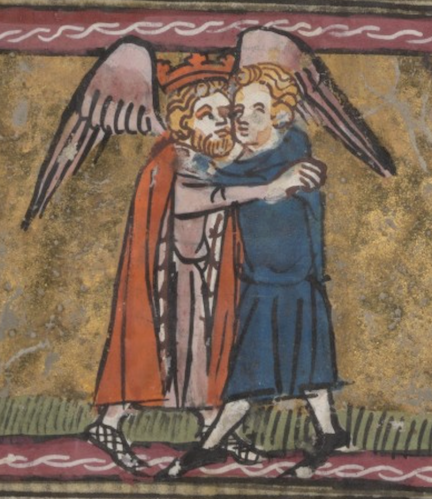
One of the most widely read love poems of the Middle Ages, the Romance of the Rose narrates an erotic dream about a man’s seduction of a woman and includes episodes about other forms of desire. Join us to hear medieval scholars Christopher T. Richards and Eliza Zingesser in conversation on the unexpected imagery inspired by this iconic work of courtly literature.

Presented in conjunction with The Met Cloisters exhibition Spectrum of Desire: Love, Sex, and Gender in the Middle Ages.

Free, though advance registration is required. Please note: Space is limited; first come, first served.

To registers and/or obtain more information, visit https://engage.metmuseum.org/events/education/talks/cloisters/free-talks/fy26/romance-of-the-rose-cloisters/

Exhibition Closing: Praymobil: Medieval art in motion, Suermondt Ludwig Museum, Aachen, Closes 15 Mar. 2026

Exhibition Closing

Praymobil

Medieval art in motion

Suermondt Ludwig Museum, Aachen, Germany

29 November 2025 - 15 March 2026

Special Opening Hours: tur-sun 10-17h

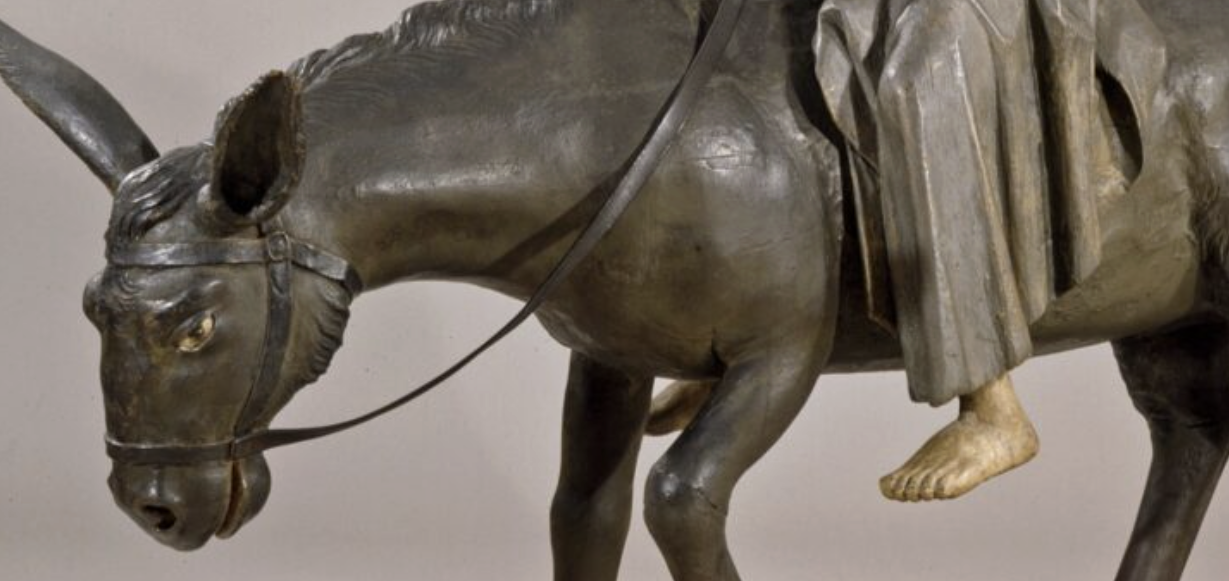
Süddeutschland (Umkreis Erasmus Grasser): Christus auf dem Palmesel reitend, um 1500, Holz/ ältere Bemalung, SLM, Aachen © Anne Gold 

Sculptures which weep, bleed, and talk, sculptures which open and close their eyes and mouths. Sculptures with movable arms and legs, as well as sculptures on wheels for processions. Sculpted doves descending from the vaults of Gothic churches into the nave to represent the Holy Ghost, and angels who seem to ascend to heaven:

Medieval participants in church liturgies, religious ceremonies, and mystery plays were keen on dramatic reenactments of biblical events. During the festive days throughout the year, they therefore set various sculptures, mostly made of wood, in motion in ritual ceremonies. Although moved by human hands, the sculptures thus appeared to be alive. This now forgotten aspect of medieval art is the subject of a fascinating exhibition at the Suermondt-Ludwig-Museum in Aachen, which demonstrates that sculptures in churches weren’t always motionless.

Instead, they were “played” with in a dignified, but also tangible manner, in order to enable people to actively participate in the history of salvation and to involve themselves emotionally in these events.

The exhibition audience is confronted with concrete uses of medieval objects, which live on in folk customs in many parts of Europe to this day. Be enchanted by 80 late medieval objects from European museums, private collections, and remote parishes in this world-first exhibition on medieval art in motion.

A complementary exhibition catalogue is available for 49,95 Euro.

For more information, visit https://suermondt-ludwig-museum.de/en/exhibition/praymobil-medieval-art-in-motion/

Call for Papers: Threads of Knowledge: Weaving and the Life of Textiles in the Middle Ages and Renaissance, Barnard College, New York City (5 Dec. 2026), Due 1 May 2026

Call for Papers

Threads of Knowledge: Weaving and the Life of Textiles in the Middle Ages and Renaissance

The 29th Biennial Conference of the Medieval and Renaissance Studies Program of Barnard College

Barnard College, New York City
December 5, 2026

Due May 1, 2026

The 29th Biennial Conference of the Medieval and Renaissance Studies Program of Barnard College. For centuries, textiles clothed bodies and books, veiled relics, marked liturgical and political boundaries, and insulated and adorned walls. Their portability and preciousness made them ideal agents of exchange. They carried forms, materials, and techniques across vast regions and cultures. It is through textiles, perhaps more than any other artistic medium, that the global interconnectedness of this historical period comes into view. At the same time, their manufacture could remain insistently local and idiosyncratic, dependent as it was—before industrustrialization—on individual touch and rhythm. Textiles could be a luxury or a thing of everyday life, and medieval and Renaissance writers exploited the double entendre of the Latin textus—both a woven and written thing—in their expositions on divinity and knowledge. Jerome characterized the Evangelists as those who “wove the truth of history” (historiae texere veritatem), a metaphor Erasmus, among others, revived in describing eloquence as a woven fabric of words. In Arabic, al-Jāḥiẓ described poetry as “a kind of weaving (ḍarb min al-nasj).”

This one-day conference invites scholars from across disciplines (archaeology, art history and conservation, history, literary studies, religion, history of science, legal history) to explore how textiles, and the metaphors they inspired, shaped medieval and Renaissance life. Topics could include but are not limited to the following: production and labor; global trade and circulation; technical knowledge and transmission; gendered and domestic craft practices; liturgical and ceremonial textiles; clothing and identity; textiles as diplomatic or political gifts; conservation and material analysis; weaving and intertextuality; and the role of textiles in shaping networks and communities.

The conference will be held Saturday, December 5, 2026 on the Barnard College campus in New York City. Tours of local collections for conference participants may take place the preceding day, Friday, December 4.

Plenary Speakers:
Timothy McCall, Villanova University
Sharon Farmer, University of California-Santa Barbara

PLEASE NOTE: The conference will be in person. While we will give preference to submissions for papers held in person, we also invite proposals from scholars who are only able to deliver papers remotely on Zoom.

Please submit an abstract of 250-300 words and a 2-page CV to Greg Bryda (gcb2128@columbia.edu)
Submission Deadline: May 1, 2026

New Scholarly Space! Byzantine Disability Hub, Informal Meeting (26 Feb. 2026, 6PM GMT/ 1PM EST) & Inaugural Lecture (9 Apr. 2026, 6PM GMT/ 1PM EST), Zoom

New Scholarly Space

Byzantine Disability Hub

Informal Meeting

Thursday February 26 at 6pm GMT / 1PM EST (Zoom)

Inaugural Lecture

Thursday 9 April at 6pm GMT / 1PM EST (Zoom)

We are pleased to announce the establishment of the Byzantine Disability Hub, a new scholarly space dedicated to exploring physical and mental difference in the Byzantine world. The Hub aims to bring together scholars, students, and all those interested in the lived experiences, representations, and social dimensions of disability in Byzantium and the medieval eastern Mediterranean.

Serving as a central platform for our activities and resources, the Byzantine Disability Hub offers a gateway to lectures, group discussions, conference updates, and a curated repository of relevant scholarship. We envision the Hub as a meeting place—one that fosters connection, collaboration, and contribution within this emerging field of study. By encouraging dialogue and highlighting ongoing work, the Hub seeks to strengthen international networks, inspire new research, and support future projects that broaden our understanding of Byzantium and its diverse communities.

We warmly invite colleagues to join us for two upcoming events:

  • an informal online meeting to meet the Hub organizers on Thursday, February 26 at 6pm GMT / 1PM EST (Zoom)

  • the inaugural lecture by Glenn Peers (University of Texas at Austin/ Syracuse University) on Community and Difference: Freaks and Byzantine ‘Healing’ on Thursday 9 April at 6pm GMT / 1PM EST (Zoom)

For more details about the Hub, please use this link: https://byzantine-disability-hub.leeds.ac.uk/

Jackson Lecture in Byzantine Art: Eastern Europe in Focus: Medieval Art, Cultural Heritage, and Global Conflicts, Alice Isabella Sullivan, Online & At Temple University, 6 Feb. 2026 4:30-6:00pm

Jackson Lecture in Byzantine Art

Eastern Europe in Focus: Medieval Art, Cultural Heritage, and Global Conflicts

Alice Isabella Sullivan

Online & In-Person

Tyler School of Art and Architecture, Temple University, Philadelphia, PA

Friday, 6 February 2026, 4:30-6:00pm

This lecture explores aspects of the history and art of Eastern Europe, which developed at the intersection of competing traditions and worldviews for much of the Middle Ages. Byzantium played a key role in shaping local artistic developments in regions of the Balkan Peninsula, the Carpathian Mountains, and further north, as did contacts with Western and Central Europe. Key objects and monuments reflect aspects of local negotiations among competing traditions, and the shifting meanings and functions of cultural heritage during moments of change, crisis, and conflict. Examples from regions of modern Ukraine, Romania, and North Macedonia, among others, underscore the importance of putting Eastern Europe in focus temporally, geographically, methodologically, and theoretically within the study of medieval, Byzantine, post-Byzantine, and early modern art history.

Alice Isabella Sullivan, PhD, is Assistant Professor and Director of Graduate Studies in the Department of the History of Art and Architecture at Tufts University. She specializes in the artistic production of Eastern Europe and the Byzantine-Slavic cultural spheres in the period between the 14th and 16th centuries. Sullivan is the author of the award-winning book The Eclectic Visual Culture of Medieval Moldavia (2023), Europe’s Eastern Christian Frontier (2024), and co-editor of several volumes. In addition, she is co-director of the Sinai Digital Archive, and co-founder of North of Byzantium and Map­ping Eastern Europe – two initiatives that explore the history, art, and culture of the northern frontiers of the Byzantine Empire in Eastern Europe during the medieval and early modern periods.

This event is free and open to the public. A reception will follow the lecture. Attendees can join in-person in ARCH 104 or virtual via Zoom (https://temple.zoom.us/meeting/register/YEJDqOhrSdGUT4v7hktfUQ)

The Jackson Lecture in Byzantine Art is generously sponsored by Lynn Jackson, with additional support from Temple University's General Activities Fund (GAF).

For more information, visit https://now.temple.edu/events/2026-02-06/jackson-lecture-byzantine-art-eastern-europe-focus-medieval-art-cultural-heritage-global-conflicts

Call for Proposals: AVISTA SMART Grant, Due 15 March 2026

Call for Proposals

AVISTA SMART Grant

Due 15 March 2026

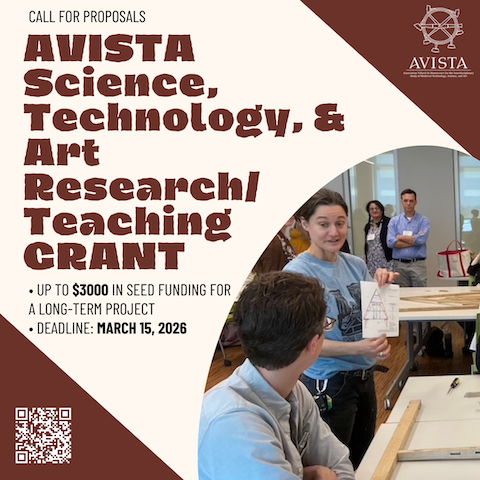
The AVISTA START (Science, Technology, and Art Research/Teaching) Grant is a new award that provides up to $3,000 USD in seed funding for the initial stages of a long-term scholarly project. It is sponsored by Robert E. Jamison, Professor Emeritus of Mathematics at Clemson University, in collaboration with AVISTA (the Association Villard de Honnecourt for the Interdisciplinary Study of Medieval Technology, Science, and Art).

The grant is open to any Ph.D.-holding researcher (full-time faculty, part-time faculty, or independent scholar). Eligible projects must engage the intersection of science, technology, and art or architecture in the medieval world—with a preference for initiatives that feature a public—facing component. Examples include, but are not limited to, publications, exhibitions, symposia, conferences, public demonstrations, research resources, and teaching resources.

The submission deadline is Sunday, March 15, 2026. Complete applications will be reviewed by AVISTA’s Grants and Awards Committee. The winning recipient will be notified in mid-April and announced at AVISTA-sponsored events at the International Congress on Medieval Studies in Kalamazoo, Michigan, in mid-May.

All questions and applications should be sent to:

Sarah Thompson at: avistatreasurer@gmail.com

NOTE ON FILE SUBMISSION: Please submit PDF files when appropriate with the file named as LAST NAME first, then the item.

Example: SMITHdescription.pdf, SMITHbudget.pdf, SMITHcv.pdf


Applicants are asked to submit the following materials for consideration:

  1. A CV (curriculum vitae).

  2. Project summary, including a title, list of goals, list of products, and discussion of the expected project impact (two pages max)

  3. Project timeline, including a description of which portion of the initiative would be covered by the grant (one page)

  4. Project budget, including a description of which portion of the initiative would be covered by the grant (one page)

  5. List of additional funding sources to which the applicant has applied or will apply to ensure the successful completion of the project (one page).


For more information, visit: https://www.avista.org/opportunities-prizes-and-grants

Exhibition Closing: Spectrum of Desire: Love, Sex, and Gender in the Middle Ages, The MET Cloisters, New York, Until 29 Mar. 2026

Exhibition Closing

Spectrum of Desire: Love, Sex, and Gender in the Middle Ages

Gallery 002, The MET Cloisters, New York, NY

Through March 29, 2026

Free with Museum admission

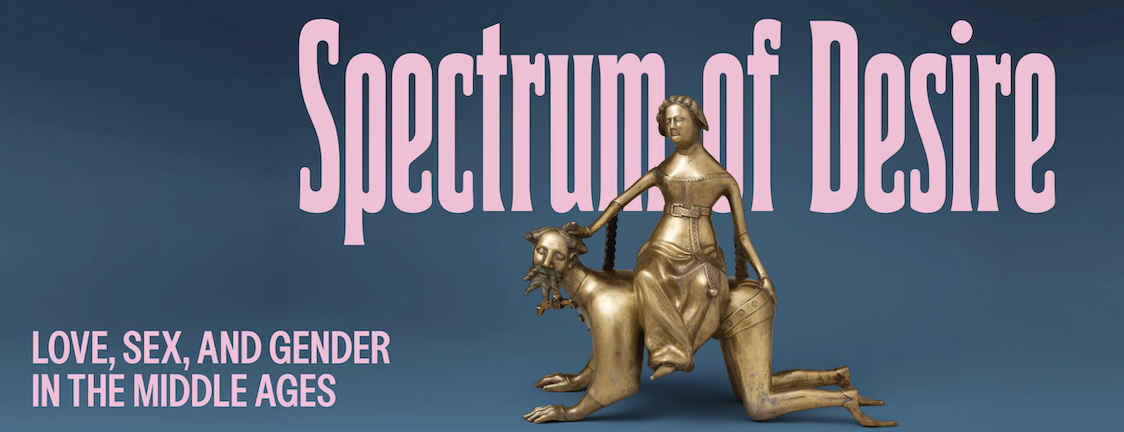
Set in the stunning atmosphere of The Met Cloisters, this exhibition explores the often-overlooked themes of desire, sexuality, and gender in the medieval past, a period of time when most artistic production served religious purposes.

Desire in the Middle Ages was multifaceted. It could be courtly or carnal, sacred or subversive, and expressed as a kind of longing, suffering, or joy. Medieval artists could be both deeply serious and comical in their evocations of these feelings. Drawing on decades of scholarship, Spectrum of Desire opens up new ways of seeing the past through stirring works of art that inspire us to think more expansively about people who lived in the Middle Ages, their relationships, and the artworks they produced.

Featuring more than fifty works—from gold jewelry and ivory sculptures to stained glass, illuminated manuscripts, and woven textiles—this exhibition showcases the richness of visual expression in western Europe from the 13th to the 15th century, drawing primarily from The Met collection. This exploration of the visual language of desire in its many forms invites us to reflect on our own ideas of love, identity, and kinship today.

The exhibition is made possible by the Michel David-Weill Fund and Kathryn A. Ploss.
The catalogue is made possible by the Michel David-Weill Fund and Nellie and Robert Gipson.
Additional support is provided by Wendy A. Stein and Bart Friedman.

For more information, visit https://www.metmuseum.org/exhibitions/spectrum-of-desire-love-sex-and-gender-in-the-middle-ages

Exhibition Closing: GLOBAL Nuremberg 1300–1600, GERMANISCHES NATIONALMUSEUM, Nuremberg, Until 22 Mar. 2026

Exhibition Closing

GLOBAL Nuremberg 1300–1600

GERMANISCHES NATIONALMUSEUM, Nuremberg, Germany

25/09/2025 – 22/03/2026

This special exhibition focuses on Nuremberg’s global networks between 1300 and 1600, the city’s importance as an international trading center in the heart of Europe, and its cultural interactions worldwide. At the same time, the GNM critically reflects on Nuremberg’s role, past and present, in an increasingly globalized world.

Nuremberg was a hub for luxury goods arriving on trade routes from all corners of the world, while businesses such as the arms trade contributed to the city’s thriving prosperity. Churches and ruling dynasties from all over Europe ordered works of art and other precious items here, while most of the traded goods were mass-produced in serial workshop production.

But global trade went far beyond the import and export of goods and raw materials. Pilgrims, merchants, diplomats, and artists from Nuremberg traveled the world. Their city became an important center for the dissemination of news of all kinds. Countless broadsheets and pamphlets describing European expeditions and the people and animals of distant lands were printed in Nuremberg. The world’s oldest surviving globe, the Behaim Globe, was made here.

Nuremberg imported raw materials, too, from all over the world, such as coconuts, ostrich eggs, and sea snails, which local goldsmiths turned into ornate, luxury cups. Artists traveled to Nuremberg from far and wide to hone their skills and take their newfound knowledge back out into the world.

Albrecht Dürer’s motifs were replicated by Indian illuminators, and his famous rhinoceros even appears on a mural as far away as Colombia.

But the exhibition also highlights the darker side of early-modern globalization. Nuremberg merchants were involved in the transatlantic slave trade and the colonization of the Americas. Together with the Portuguese, they waged brutal economic wars on the east coast of Africa and in India.

The exhibition brings together a large number of high-caliber loans from across Europe, all of which relate to Nuremberg and illustrate the city’s many entanglements in early global history.

To buy tickets, visit: https://onlineshop.gnm.de/de/tickets/eintrittskarte

Free admission on Wednesdays from 17.30.

For more information, visit: https://www.gnm.de/your-museum-in-nuremberg/ausstellungen/aktuell/nuernberg-global

BAA Annual Lecture Series, Society of Antiquaries of London, First Wednesday of the Month, February-May

BAA Annual Lecture Series

Society of Antiquaries of London

First Wednesday of the Month, February-May

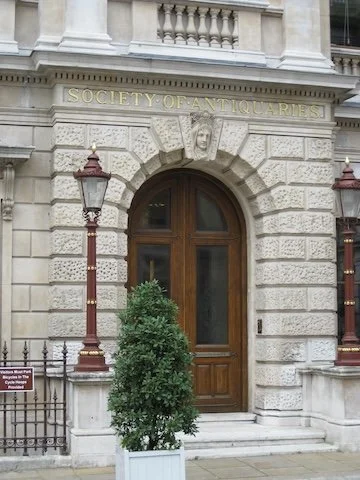
The BAA holds regular monthly lectures on the first Wednesday of each month, between October and May in the rooms of the Society of Antiquaries of London. Council meetings precede the lectures on dates marked with an asterisk (*). Tea is served from 5 p.m. and the Chair is taken at 5.30 p.m. 

The lectures provide an opportunity for professionals, students and independent scholars to present research that falls within the BAA’s areas of interest.  We aim to cover both British and European topics that are susceptible to art-historical, archaeological, architectural, and historiographical investigation between the Roman period and the 19th century, but with a bias towards the medieval period.

The lectures are open to all; non-members are welcome to attend occasional lectures but are asked to make themselves known to the Hon Director on arrival, and to sign the visitors book.

For more information and previous lectures, visit https://thebaa.org/meetings-events/lectures/annual-lecture-series/

Lectures

Wednesday, 4 February 2026

Building for strangers: recent research on England’s medieval inns, Matthew Cooper

Wednesday, 4 March 2026

The transformation of the monastic enclosure at Marmoutier (Tours, France) between the 11th and the early 13th centuries, Elisabeth Lorans, Emeritus Professor of Medieval Archaeology, University of Tours (France)

Wednesday, 1 April 2026

Thumbnails, or A Digital Wild Goose Chase, Jack Hartnell

Wednesday, 6 May 2026

The Papal Palace in Avignon in the light of regional architecture, Alexandra Gajewski

Lecture: Byzanz an der Spree. Das Ravennatische Mosaik aus San Michele in Africisco „revisited“, Michail Chatzidakis, HU-Hauptgebäude, 4 Feb. 2026 14:15-15:45 UHR

Lecture

Byzanz an der Spree. Das Ravennatische Mosaik aus San Michele in Africisco „revisited“

Michail Chatzidakis

4 Februrary 2026

Mittwochs, 14:15-15:45 Uhr

HU-Hauptgebäude, HS 3075, Unter den Linden 6

Eine Veranstaltung des Instituts für Kunst- und Bildgeschichte

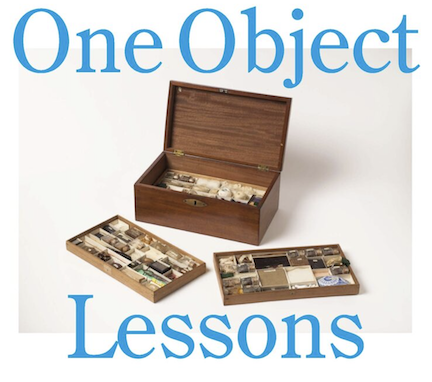
Bildnachweis: Educational specimen box, ca. 1850, (e) V&A Museum, London.

Lecture Series

The Latin word ‘objectum,’ root of the modern English object or German Objekt, means that which is thrown before, which stands in the way, which objects ; it is that on which thought stumbles but also that on which thought rests and to which it refers. In focusing on objects, understood both abstractly as ‘objects of study’ and concretely as things in the world, we point to one of the basic questions of research in the humanities : what is the relationship of the general to the singular ? How can we be true to the experience, motivations, and choices of individuals while also understanding broader currents of historical change?

A focus on individual objects in their materiality both results from and results in object-centered museum collections and exhibits. It is part and parcel of the history of art-historical method, already present in the establishment of art history as an academic discipline in the nineteenth century. Then, the object served as a necessary but problematic locus for the attempt to reconcile the criticism of style with the study of historical context. Today, art history is characterized by a great methodological plurality, which can be said to respond to the insurmountable resistance of objects to complete mental appropriations: since objects can never be fully grasped by the mind, some aspects always fall away or fade to the background, needing to be recovered by a new approach. Among these, the material turn has contributed to recentering objects and their materiality in art-historical inquiry. Within the Ringvorlesung, or lecture series, ‘One-Object Lessons,’ lecturers and researchers at the Institut für Kunst- und Bildgeschichte present case studies around individual objects — from the large-scale and monumental to the smallest and most fragile — and reflect over their methodological approaches. Each object — textile, mosaic, building, paper, painting or sculpture — enables its interlocutor (among other issues) to illuminate different aspects of a specific historical context ; each object also throws up its own methodological challenges.
The talks and dicussions will be held in German or English.

RVL_One-Object_Lessons_Programm_final

For more information, visit https://www.kunstgeschichte.hu-berlin.de/2025/09/ringvorlesung-one-object-lessons-ws-2025-26/

Exhibition: Fastnacht: Dance and Games at the Nuremberg Carnival, Germanisches National Museum, Nuremberg, 11 Nov. 2025 – 15 Feb. 2026

Exhibition

Fastnacht: Dance and Games at the Nuremberg Carnival

Germanisches National Museum, Nuremberg, Germany

11.11.2025 – 15.02.2026

What is known in Germany as the ‘fifth season’ has brought joy to people for centuries. Nuremberg became a carnival hotspot in the Late Middle Ages, based on customs steeped in the liturgical year.

On the occasion of the city’s 975th anniversary, the special exhibition ‘Fastnacht: Dance and Games at the Nuremberg Carnival’ presents the fascinating history of Nuremberg’s nearly 600-year-old carnival tradition.

In addition to the many popular Fastnachtsspiele (carnival plays) that are performed in taverns and homes to this day, the people of Nuremberg started celebrating the so-called Schembartlauf (‘bearded-mask’ parade) in the early 15th century. Participants dressed in colorful costumes paraded through the city center, enacting a ‘topsy-turvy world’ and handing out sweetmeats. Within a few decades, the patriciate had transformed the Schembartlauf into an extravagant procession with increasingly elaborate costumes.

The starting point of the exhibition are the precious Schembart books, which were produced in large numbers after the arrival of the Reformation. They found their way around the world and continue to provide insight into the history of the Nuremberg Fastnacht.

What does a closer look at these books reveal? It becomes clear that those involved had political motives and a hunger for power and prestige. What was the Nuremberg Fastnacht really like, beyond the crafted image conveyed in such depictions? The exhibition invites you to embark on a journey through history and explore the Nuremberg Fastnacht through interactive exhibits and a stimulating educational and events program for young and old.

To buy tickets, visit https://onlineshop.gnm.de/de/tickets/eintrittskarte.

Free admission on Wednesdays from 17.30

For more information, visit https://www.gnm.de/your-museum-in-nuremberg/dont-miss/special-exhibitions/carnival.

Call for Papers: Religious Identities and Funerary Landscapes in Late Antiquity, EABS Annual Conference, Leuven, Belgium (20-23 July 2026), Due by 31 Jan. 2026

Call for Papers

EABS Annual Conference 2026

Religious Identities and Funerary Landscapes in Late Antiquity: Mortuary Practices and Social Aspects among Christians, Jews, and Pagans

20th-23rd July 2026, Leuven, Belgium

Due by 31 January 2026

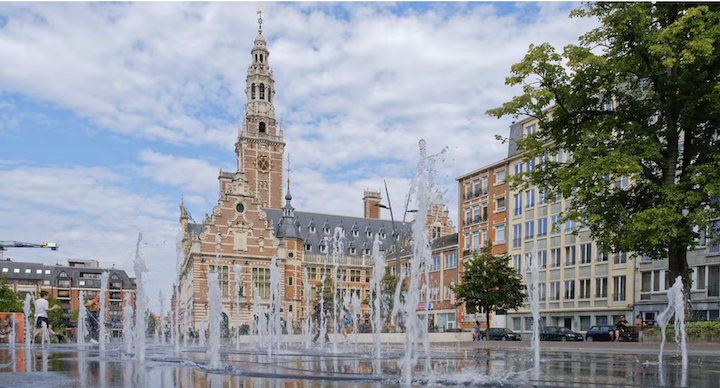
University Library @ Herbert Hooverplein © Filip Van Loock.

Research Unit: Jews, Christians, and the Materiality of Mortuary Rituals in Late Antiquity

In the third and final year of the research unit 'Jews, Christians, and the Materiality of Mortuary Rituals in Late Antiquity', we will focus on mortuary space, namely, on the placement of burials of Jews and Christians in their funerary contexts and in the mortuary landscape in Late Antiquity.

We will discuss the social aspects related to the communities performing mortuary rituals, and the idea that these practices seem to be directed towards the ongoing social personhood of the deceased. We will also discuss how different religious identities (Christian, Jewish and 'pagan') fuse and blend into a more general late antique group identity, depending on the regional or social context.

Furthermore, the panel will address the complex interplay between different religious traditions Christian, Jewish, and 'pagan'— and the ways in which these traditions could be both distinct and intertwined. We will consider how regional variations, urban versus rural contexts, and socio-political factors influenced the extent to which these religious groups maintained separate burial practices or integrated their funerary customs, sometimes resulting in shared mortuary traditions.

Our aim is to combine archaeological evidence, epigraphic sources, and historical texts, employing interdisciplinary methodologies including spatial analysis, material culture studies, and social theory. We will also consider the impact of legal regulations, economic factors, and urban planning on burial practices.

Ultimately, this comprehensive approach seeks to illuminate how mortuary landscapes functioned as dynamic spaces where identity, memory, and social relations were continually re-constructed and re-negotiated in Late Antiquity.

We will accept proposals for papers from a multidisciplinary perspective: scholars of archaeology, art history, iconography, architecture, epigraphy, hagiography, Late Antiquity, early Christian literature, and ancient history. Additionally, all related disciplines are welcome to submit a paper.

The following topics are suggested, but any other relevant topics are welcome as well:

  • Funerary Landscapes and Urban/Suburban Contexts: The location of the necropolises in relation to urban contexts and/or nearby settlements; communication routes; shared or contiguous funerary spaces.

  • Continuity and Transformation of Mortuary Customs: The examination of mortuary practices amid religious and social changes in Late Antiquity.

  • Funerary Architecture and Monuments: The analysis of architectural forms of burials and funerary monuments.

  • Religious Markers in Multi-Confessional Funerary Contexts: The meaning and interpretation of symbols in shared or adjacent funerary spaces.

  • Religious Identity and Social Stratification: The investigation of social hierarchies within religious communities and how these are reflected in expressions of identity within funerary spaces.

  • New Archaeological and Interdisciplinary Techniques for the Study of Late Antique Cemeteries: The use of GIS, archaeobotanical, anthropological, and bioarchaeological analyses conducted in recent excavation contexts.

You are invited to submit an abstract (maximum 300 words) accompanied by a short CV via EABS's systems by 31st January 2026. All submissions should include your name, e-mail address and academic affiliation (if applicable).

Participants are expected to give a 20-30-minute talk, followed by a session for discussion. A publication of the contributions is planned. Further information will be provided during the conference.

If you would like to receive further information or submit an abstract, please visit the EABS website at the following page: https://eabs.my.site.com/

Call for Papers: Violence in the Medieval and Early Modern North, Aberdeen Medieval and Early Modern Conference, University of Aberdeen (25-26 May 2026), Due by 29 Jan. 2026 at 18:59 ET/23:59 GMT

Call for Papers

Violence in the Medieval and Early Modern North

Aberdeen Medieval and Early Modern Conference

25-26 May 2026, University of Aberdeen, Scotland

Due by 29 January 2026 at 18:59 (ET)/ 23:59 (GMT)

At the second annual Aberdeen Medieval and Early Modern Conference, we encourage researchers to explore how violence was interpreted, enacted and avoided in the medieval and early modern north. How does the reality of the medieval and early modern world reflect how we view the past? How did distinct or militaristically violent roles (i.e. Vikings, Knights and Musketeers) handle the violence of their occupations? Do we still enact violence on the past as researchers? What were the aftereffects of violence, on the body, on architecture, and on society?

We are seeking papers on the topic of violence and its intersections with:

  • Memory and Trauma

  • Judicial and Legal Systems

  • Literature and Art History

  • Gender, Race, Class, and Disability Studies

  • Military and War Studies

  • Religious and Ecclesiastical History

  • Histories of Medicine and the Body

  • Medievalism and Early Modern Reception

  • History of Emotions (e.g. anger, humour etc.)

  • Ecocriticism

  • Manuscript Studies and Material Culture

While we invite papers on all parts of the north, we especially welcome papers on Aberdeen and northern Scotland.

The conference will be held on 25-26 May 2026 at the University of Aberdeen, Scotland.

Please email abstracts of no more than 250 words to medievalandearlymodernaberdeen@gmail.com.

Deadline: 29 January 2026 @ 23:59 (GMT)