Call for Papers
EABS Annual Conference 2026
Religious Identities and Funerary Landscapes in Late Antiquity: Mortuary Practices and Social Aspects among Christians, Jews, and Pagans
20th-23rd July 2026, Leuven, Belgium
Due by 31 January 2026
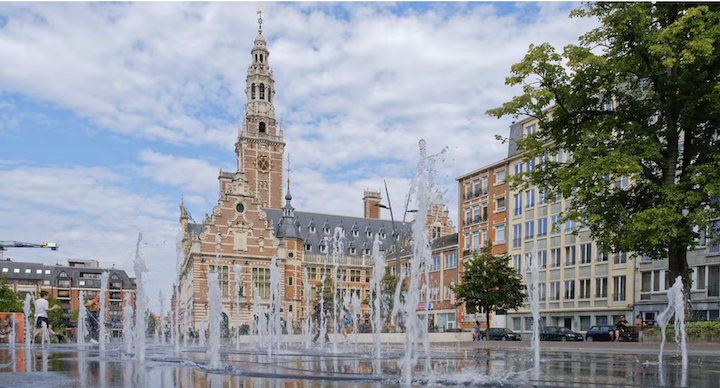
University Library @ Herbert Hooverplein © Filip Van Loock.
Research Unit: Jews, Christians, and the Materiality of Mortuary Rituals in Late Antiquity
In the third and final year of the research unit 'Jews, Christians, and the Materiality of Mortuary Rituals in Late Antiquity', we will focus on mortuary space, namely, on the placement of burials of Jews and Christians in their funerary contexts and in the mortuary landscape in Late Antiquity.
We will discuss the social aspects related to the communities performing mortuary rituals, and the idea that these practices seem to be directed towards the ongoing social personhood of the deceased. We will also discuss how different religious identities (Christian, Jewish and 'pagan') fuse and blend into a more general late antique group identity, depending on the regional or social context.
Furthermore, the panel will address the complex interplay between different religious traditions Christian, Jewish, and 'pagan'— and the ways in which these traditions could be both distinct and intertwined. We will consider how regional variations, urban versus rural contexts, and socio-political factors influenced the extent to which these religious groups maintained separate burial practices or integrated their funerary customs, sometimes resulting in shared mortuary traditions.
Our aim is to combine archaeological evidence, epigraphic sources, and historical texts, employing interdisciplinary methodologies including spatial analysis, material culture studies, and social theory. We will also consider the impact of legal regulations, economic factors, and urban planning on burial practices.
Ultimately, this comprehensive approach seeks to illuminate how mortuary landscapes functioned as dynamic spaces where identity, memory, and social relations were continually re-constructed and re-negotiated in Late Antiquity.
We will accept proposals for papers from a multidisciplinary perspective: scholars of archaeology, art history, iconography, architecture, epigraphy, hagiography, Late Antiquity, early Christian literature, and ancient history. Additionally, all related disciplines are welcome to submit a paper.
The following topics are suggested, but any other relevant topics are welcome as well:
Funerary Landscapes and Urban/Suburban Contexts: The location of the necropolises in relation to urban contexts and/or nearby settlements; communication routes; shared or contiguous funerary spaces.
Continuity and Transformation of Mortuary Customs: The examination of mortuary practices amid religious and social changes in Late Antiquity.
Funerary Architecture and Monuments: The analysis of architectural forms of burials and funerary monuments.
Religious Markers in Multi-Confessional Funerary Contexts: The meaning and interpretation of symbols in shared or adjacent funerary spaces.
Religious Identity and Social Stratification: The investigation of social hierarchies within religious communities and how these are reflected in expressions of identity within funerary spaces.
New Archaeological and Interdisciplinary Techniques for the Study of Late Antique Cemeteries: The use of GIS, archaeobotanical, anthropological, and bioarchaeological analyses conducted in recent excavation contexts.
You are invited to submit an abstract (maximum 300 words) accompanied by a short CV via EABS's systems by 31st January 2026. All submissions should include your name, e-mail address and academic affiliation (if applicable).
Participants are expected to give a 20-30-minute talk, followed by a session for discussion. A publication of the contributions is planned. Further information will be provided during the conference.
If you would like to receive further information or submit an abstract, please visit the EABS website at the following page: https://eabs.my.site.com/