Lecture
Byzanz an der Spree. Das Ravennatische Mosaik aus San Michele in Africisco „revisited“
Michail Chatzidakis
4 Februrary 2026
Mittwochs, 14:15-15:45 Uhr
HU-Hauptgebäude, HS 3075, Unter den Linden 6
Eine Veranstaltung des Instituts für Kunst- und Bildgeschichte
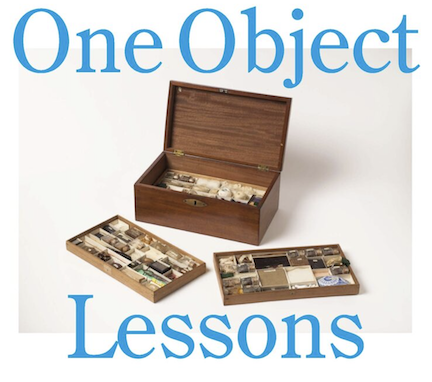
Bildnachweis: Educational specimen box, ca. 1850, (e) V&A Museum, London.
Lecture Series
The Latin word ‘objectum,’ root of the modern English object or German Objekt, means that which is thrown before, which stands in the way, which objects ; it is that on which thought stumbles but also that on which thought rests and to which it refers. In focusing on objects, understood both abstractly as ‘objects of study’ and concretely as things in the world, we point to one of the basic questions of research in the humanities : what is the relationship of the general to the singular ? How can we be true to the experience, motivations, and choices of individuals while also understanding broader currents of historical change?
A focus on individual objects in their materiality both results from and results in object-centered museum collections and exhibits. It is part and parcel of the history of art-historical method, already present in the establishment of art history as an academic discipline in the nineteenth century. Then, the object served as a necessary but problematic locus for the attempt to reconcile the criticism of style with the study of historical context. Today, art history is characterized by a great methodological plurality, which can be said to respond to the insurmountable resistance of objects to complete mental appropriations: since objects can never be fully grasped by the mind, some aspects always fall away or fade to the background, needing to be recovered by a new approach. Among these, the material turn has contributed to recentering objects and their materiality in art-historical inquiry. Within the Ringvorlesung, or lecture series, ‘One-Object Lessons,’ lecturers and researchers at the Institut für Kunst- und Bildgeschichte present case studies around individual objects — from the large-scale and monumental to the smallest and most fragile — and reflect over their methodological approaches. Each object — textile, mosaic, building, paper, painting or sculpture — enables its interlocutor (among other issues) to illuminate different aspects of a specific historical context ; each object also throws up its own methodological challenges.
The talks and dicussions will be held in German or English.
RVL_One-Object_Lessons_Programm_final
For more information, visit https://www.kunstgeschichte.hu-berlin.de/2025/09/ringvorlesung-one-object-lessons-ws-2025-26/