Exhibition
Ten Kings of Hell: The Afterlife in Medieval Korea
Sunday, October 11, 2026–Sunday, January 3, 2027
003 Special Exhibition Hall, The Kelvin and Eleanor Smith Foundation Exhibition Hall
The Cleveland Museum of Art, OH
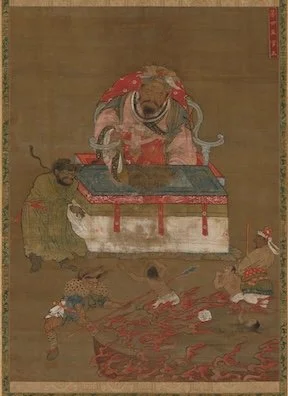
The Fourth King of Hell, late 1300s. Korea, Goryeo dynasty (918–1392).
Organized in partnership with the National Museum of Korea, this landmark international exhibition, Ten Kings of Hell: The Afterlife in Medieval Korea, explores the artistic legacy of the Goryeo dynasty (918–1392), posing daring questions: How did medieval Koreans envision the world beyond death and how did works of art and materiality shape and reflect that imagined realm?
Presenting an exceptional array of important artworks, including the CMA’s recent acquisitions—the Fourth King of Hell from the late 1300s, the Knife Sheath from the 1100s (Apollo’s Acquisition of the Year Award 2022), and the Kṣitigarbha Bodhisattva from the 1300s—the exhibition unfolds across three interlocking sections, each illuminating the soul’s passage from death through purgatory to the Buddhist paradise. At its dramatic center is the historic reunification of a dispersed set of 10 hanging scrolls from the 1300s depicting the 10 Kings of Hell. Brought together for the first time since the 1960s, the scrolls offer a rare opportunity to experience the set’s panoramic sequence of judgment, atonement, and salvation.
Among its most compelling narratives, the exhibition examines how sociopolitical upheavals and environmental pressures shaped medieval Korea’s deep preoccupation with purgatorial afterlife—not only as a moral and devotional terrain but also as a response to broader natural forces, from climatic volatility during the Little Ice Age to the devastating reach of the Black Death. A select group of contemporary artworks is also included to underscore the enduring resonance of humanity’s existential concerns.
Anicka Yi’s Bending Willow Branches (2025) makes a strong opening statement: that death adds to life’s continuum—mutating, persisting, and transforming rather than ending it. Park Chan-kyong’s Belated Bosal (2019) serves as a visually and psychologically immersive centerpiece, prompting viewers to confront human-induced environmental catastrophes and their far-reaching karmic consequences. The circuit further widens with The Third King of Hell Afterimage (2025) by 2025 MacArthur Fellow Gala Porras-Kim, created specifically for this show as a critical inquiry into the afterlives of objects within Western collecting practices.
Additionally, the exhibition incorporates innovative digital experiences that deepen engagement with the artworks and themes. Visitors have the opportunity to interact with the Sutra Container in 3-D and to look closer into the artwork by exploring intricate details of select paintings on a large-scale “Zoom Wall.” Complementing these visual experiences are carefully designed audio and video installations, from the meditative resonance of a Buddhist temple bell to the evocative projection of contemporary works.
Featuring more than one hundred works drawn from leading public and private collections in Korea, Japan, the United States, and the United Kingdom, Ten Kings of Hell: The Afterlife in Medieval Korea is accompanied by a substantial, richly illustrated catalogue, anchored in the contributing scholars’ shared commitment to transregional and interdisciplinary investigation.
For more information, visit https://www.getty.edu/exhibitions/creation-story/