Call for Papers: British Archaeological Association Postgraduate Conference (Online, 27 Nov. 2025), Due by 31 July 2025

Call for Papers

British Archaeological Association Postgraduate Conference

Online, 27 November 2025

Due by 31 July 2025

The BAA invites proposals by postgraduate and early career researchers in the field of medieval art history, architecture and archaeology. Papers can be on any aspect of the medieval period, from antiquity to the Later Middle Ages, across all geographical regions.

Send proposals of about 250 words for a 20 minute paper along with CV, to postgradconf@thebaa.org by 31 July 2025.

The conference will take place online on Thursday 27 November, with potentially a second day on Friday 28 November

Call for Papers: Metropolitan Museum Journal, Due by 15 September 2025

Call for Papers

Metropolitan Museum Journal

Sponsored by the Metropolitan Museum of Art

Due By 15 September 2025

The Editorial Board of the peer-reviewed Metropolitan Museum Journal invites submissions of original research on works in the Museum’s collection. Beginning with Volume 52 (2017), there will be two sections: Full-length Articles and Research Notes. Full-length Articles contribute extensive and thoroughly argued scholarship. Research Notes typically present a concise, neatly bounded aspect of ongoing study, such as the presentation of a new acquisition or attribution, or a specific, resonant finding from technical analysis. All texts must take works of art in the collection as the point of departure.

We look forward to receiving your submission, whether a first-time investigation or a critical reassessment from the Museum's vast holdings.

To be considered for the following year’s volume, the complete article must be submitted by September 15.

Click here for more information.

Click here to view inspiration from the Collection

View the Journal here

View the instructions for authors 

Exhibition: From the Vault: Collecting Tapestries at the Worcester Art Museum, Until 27 July 2025

Exhibition

From the Vault: Collecting Tapestries at the Worcester Art Museum

Gallery 223, Worcester Art Museum, Massachusetts

May 3, 2025–July 27, 2025

Colijn de Coter, The Last Judgment, about 1500, wool and silk tapestry, Museum Purchase, 1935.2

Tapestries: intricately designed, meticulously crafted, and often staggering in size. Delve into the history of tapestries as an art form, the methods by which they were created, the fascinating stories that brought them to the Worcester Art Museum, and their important role as a source of artistic creativity and innovation across disparate cultures and time periods. From the Vault features nearly 30 works—rarely on view due to their sensitivity to light—including 12 large-format tapestries and tapestry fragments spanning Antiquity to the present day.

Among the works on view is the massive, remarkably detailed 16th-century Flemish Last Judgment tapestry. One of the most significant Renaissance tapestries in America, it measures over 12 feet tall and more than 26 feet wide and will be on view for the first time in nearly a decade. Another highlight, Jean Lurçat’s Harvest Time (1937), marks a revival of tapestries as a medium for modern expression through its bold forms and vivid colors. This exhibition also marks the museum debut of dream disk (2024), a new acquisition by LA-based artist Diedrick Brackens (b. 1989), who is known for his intricate textile art that explores themes of identity, race, and queerness through the narratives he weaves.

This exhibition is curated by Delaney Keenan, Assistant Curator of European Art, in collaboration with Claire C. Whitner, the Museum’s Director of Curatorial Affairs and James A. Welu Curator of European Art.

For more information on the exhibition, click here.

Exhibition: Dark Ages? Jewelry from the Visigoth, Ostrogoth and Frankish Kingdoms, Sam Fogg, London, Until 5 July 2025

Exhibition

Dark Ages? Jewelry from the Visigoth, Ostrogoth and Frankish Kingdoms

Sam Fogg, London, England

5 June - 4 July 2025

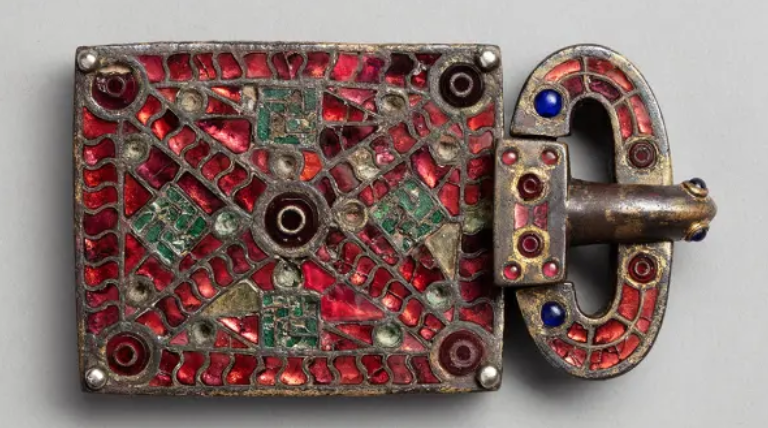
A belt buckle with garnet loop and saltire cross, c. 540-560, Visigothic Spain

Dark Ages? invites you to reconsider the narrative of decline often associated with the 5th to 7th centuries. Featuring intricately crafted belt buckles and brooches from the Visigothic, Merovingian, and Ostrogothic Kingdoms, the exhibition reveals a world rich in artistry and cultural vitality. Adorned with red garnets, vibrant glass inlays, and sumptuous gilding, these ornate objects challenge the notion of a cultural void and instead showcase an era of remarkable craftsmanship and aesthetic sophistication.

For more information, visit https://www.samfogg.com/exhibitions/63/.

Exhibition: Words on the Wave: Ireland and St. Gallen in Early Medieval Europe, National Museum of Ireland, Archaeology, Dublin, Until 24 October 2025

Exhibition

Words on the Wave: Ireland and St. Gallen in Early Medieval Europe

National Museum of Ireland

Archaeology, Kildare St, Dublin 2 D02 FH48

30th May 2025 until 24th October 2025


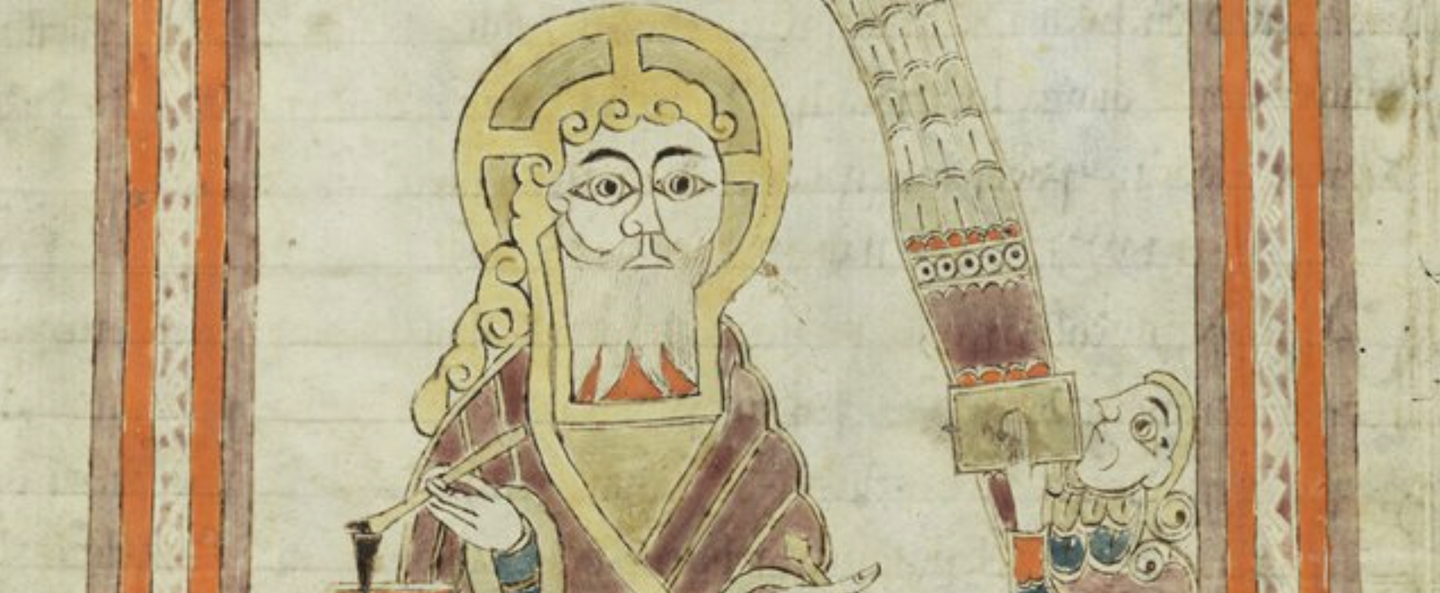
Detail showing St Matthew applying a scribal knife or scraper to a page and dipping his pen in an inkwell (Cod. Sang. 1395, p. 418). © Stiftsbibliothek, St. Gallen

Experience the magic of metal, stone and manuscript art from Ireland’s Golden Age in this unique exhibition of early medieval treasures at the National Museum of Ireland, Kildare St. Explore extraordinary journeys of people, books and ideas between medieval Ireland and Europe. Immerse yourself in precious manuscripts from the Abbey of St Gall, Switzerland — some returning to Ireland for the first time in 1000 years — alongside spectacular objects from the Irish world from which they emerged.

For more information on the exhibition, click here.

Exhibition: Text & SpiritIlluminated Manuscripts from the Museum Collection and Their Digitization, Museum Angewandte Kunst, Frankfurt, Germany, Until 22 June 2025

Exhibition

Text & SpiritIlluminated Manuscripts from the Museum Collection and Their Digitization

Museum Angewandte Kunst, Frankfurt, Germany

13 March – 22 June 2025

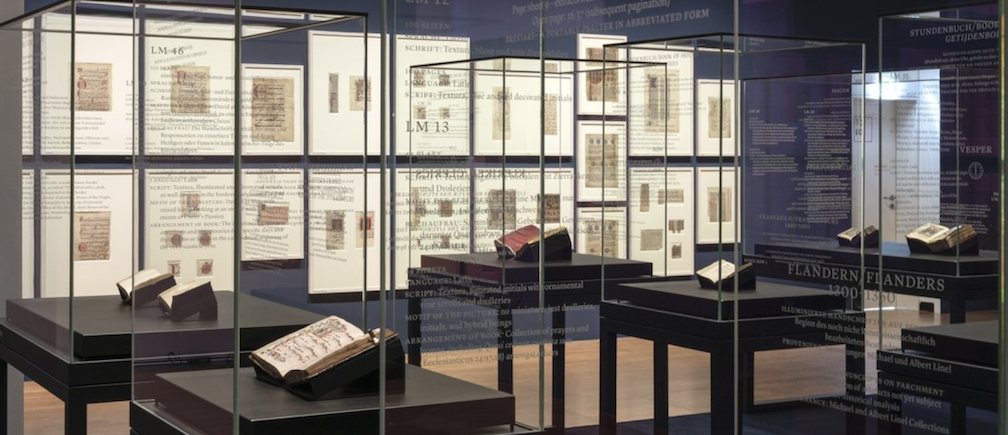
For the first time, the Museum Angewandte Kunst is showcasing its complete collection of late medieval illuminated manuscripts in the Text & Spirit exhibition. These include books and fragments decorated with exquisite illuminations and ornaments in gold, lapis lazuli or purple. What use are books of hours from the Middle Ages to us today though? Text & Spirit sheds light on various parallels between then and now, drawing a comparison between the books of hours and today’s smartphones.

The digital copies of the illuminated manuscripts and the cuttings can be found here in the digital collection.

For more information about the digitization project and the exhibition, click here.

Exhibition: Taught by the Pen: The World of Islamic Manuscripts, Beinecke Rare Book & Manuscript Library, New Haven, CT, Until 10 August 2025

Exhibition

Taught by the Pen: The World of Islamic Manuscripts

Beinecke Rare Book & Manuscript Library, Yale University, New Haven, CT

Monday, February 24, 2025 to Sunday, August 10, 2025

The Qur’an declares that God taught humanity the use of the pen. Taking this commandment to heart, Muslim scholars systematically organized and extended almost every field of knowledge in astonishing new ways. For over a thousand years, this pursuit of knowledge set in motion exchanges with other artistic, religious, and scholarly communities. Through themes such as literature, religion, and science, this exhibition reveals that Islamic civilization has never been a homogeneous phenomenon: ideas and artistic practices always circulated between and among Muslims, Jews, Christians, and other faith communities. 

Yale Library’s collection of manuscripts produced in the Islamic world is among the largest and oldest in the United States. Taught by the Pen: The World of Islamic Manuscripts celebrates Islamic civilization and its interconnected artistic, religious, and scholarly traditions. Through 150 items from the 9th to the 20th centuries, visitors are invited to engage with the intellectual and aesthetic values and practices of the many peoples and communities encompassed by Islamic civilization. The exhibition sheds light on how these manuscripts—and the ideas they contain—were transmitted and disseminated. Gallery guests will encounter diverse books, from lavishly illuminated Qur’ans, elegant calligraphy albums, and delicately illustrated epics and chronicles to well-thumbed prayer books, beloved poetry collections, detailed maps, learned science and mathematics volumes, and more. The papers, inks, and bindings that transmit these ideas and genres reveal a continuity of artistic traditions and new innovations in works from the Middle East to North Africa, Europe, Central Asia, South and Southeast Asia, and North America.

This exhibition is co-curated by Roberta L. Dougherty, Yale Library’s librarian for Middle East studies, Özgen Felek, a lector of Ottoman in the department of Near Eastern Languages and Civilizations, and Agnieszka Rec, curator at the Beinecke Library.  

For more information, visit https://beinecke.library.yale.edu/taughtbythepen

Exhibition: Summon the Chimeras: Medieval Heritage in Contemporary Art, Musée de Cluny, Paris, France, Until 20 July 2025

Exhibition

Summon the Chimeras: Medieval heritage in contemporary art

Musée de Cluny, Paris, France

25 March 2025 - 20 July 2025

This exhibition presents a number of artworks from the Fonds régional d’art contemporain Île-de-France (Île-de-France Regional Contemporary Art Fund), by artists working in the realm of the fantastical, carrying on the legacy of the medieval predilection for the hybrid and outlandish figures that inhabit our imaginations, tinged with the sense of heroic fantasy that is a frequent gateway to the Middle Ages – an often-romanticised era.

Moving through the museum, these chimeras are scattered among the museum’s own artworks, offering their interpretations of western medieval art and perpetuating its sources and their meanings: those of a predominantly Christian world imbued with spirituality, in which the visible and invisible are intertwined.

These contemporary artworks create a dialogue with medieval architecture and sculpture, in that their forms and patterns share the same wondrous, natural, botanical and animal inspirations. Many are also rooted in the history of decorative arts and religious ornaments; by revisiting the shapes of drinking horns, aquamaniles or reliquaries, for example, they refresh our imaginations of ancient customs and uses. The world that interests these contemporary artists is, first and foremost, a time that precedes the humanism of the Renaissance and the rationalism of the Enlightenment; a time whose everyday workings they strive to perceive. Directly echoing the historical artefacts showcased in the museum, these artworks help us explore the social conventions and activities of a world unto itself.

The same ancient traditions, legends and texts that fuelled the inspiration of medieval artists can be found in Jacopo Belloni’s “Green Man”, Corentin Darré’s drinking horns, Frederik Exner’s frogs and Xolo Cuintle’s “Soft Acanthus”, all of which speak to the pervasive animal and botanical motifs that permeate artworks of the past. Youri Johnson and Marion Verboom perpetuate certain votive practices by imagining contemporary forms of devotion, in which the same taste for the affective seems to forge a link between the eras, and enables us to grasp the internalisation of faith. The religious sphere generates artistic creation, and the works of Diego Giacometti and Alison Flora help us to understand the supernatural or divine power invoked therein. Finally, Erik Dietman and Richard Fauguet create echoes of items used in everyday and aristocratic life, while Lou le Forban does the same for popular and festive artefacts.

We thereby come to understand the historical transformations or legacies from which the artists, who are themselves visitors to the museum, draw inspiration in order to communicate the richness of a history that continues to fuel our imaginations and everyday customs, via the tastes and practices that emerged or took hold during the medieval era.

The exhibition is being held as part of the Berserk & Pyrrhia, art contemporain et art médiéval (“Berserk & Pyrrhia, Contemporary and Medieval Art”) programme, curated by Céline Poulin, director of the Frac Île-de-France.

Séverine Lepape, director of the Musée de Cluny, thanks the Frac, the artists and the Musée de Cluny team for putting this exhibition together.

For more information, visit https://www.musee-moyenage.fr/en/activities/exhibitions/medieval-and-contemporary-art.html

Conference: Medieval Communities, IMS Paris's 18th Annual Symposium, 3-5 July 2025

Conference

IMS Paris's 18th Annual Symposium

Medieval Communities

3-5 July 2025

Join us for a symposium convening an international group of scholars in the heart of Paris. We will hear 25 papers centered around the broad theme of community. Our keynote speakers this year are Sharon Farmer (University of California, Santa Barbara) and Cécile Voyer (Center for Advanced Studies in Medieval Civilization, University of Poitiers).

Registration to attend is still open.

For registration, a preliminary program, and more information, visit https://www.imsparis.org/en/.

For more than two decades the IMS-Paris has promoted interdisciplinary intellectual exchange among international scholars of medieval studies and colleagues in France.

A bilingual non-profit association founded in Paris in 2003 by Meredith Cohen (UCLA) and Danielle Johnson (Wells College, Paris), the IMS-Paris has grown to count a dynamic group of art and architectural historians, historians, musicologists, and literary scholars from all over the world among its members.

We organize a number of activities throughout the year to benefit medievalists who are carrying out research in France, and to help French academics gain visibility at international conferences in Europe and the Americas.

Call for Job Applications: Associate Curator and Study Center Manager, The Icon Museum and Study Center, Clinton, MA, Due 27 June 2025

Call for Job Applications

Associate Curator and Study Center Manager

The Icon Museum and Study Center, Clinton, MA

Due 27 June 2025

The Icon Museum and Study Center, founded in 2006 by the American entrepreneur Gordon Lankton, welcomes approximately 6,000 visitors annually. It houses the most comprehensive collection of historic Russian icons in the United States, along with a growing collection of Greek, Veneto-Cretan, and Ethiopian icons. The Museum’s mission is “to illuminate the art of the sacred icon for a global audience.” It offers galleries where visitors can engage with the history, beauty and spiritual depth of icons. The Museum’s Study Center promotes object-based learning and multidisciplinary research, with a commitment to sharing new insights into Eastern Christian art with wide audiences in the United States and abroad through a range of academic and public programs.

Position overview

We are seeking a dynamic Associate Curator and Study Center Manager to join our dedicated team of eight staff members. The ideal candidate is a collaborative professional with strong organizational, communication, and writing skills, and is capable of working to the highest museum standards.

The candidate will be responsible for organizing and managing two exhibitions per year at the IM+SC, as well as for implementing and managing the Study Center’s programs and activities in close coordination with the Study Center Committee. 

For more information and to submit your application, visit https://www.iconmuseum.org/employment/.

Call for Applications: North of Byzantium Assistant Editor, Due By 31 July 2025

Call for Applications

North of Byzantium

Assistant Editor

North of Byzantium and Mapping Eastern Europe Projects During 2025-2026 Academic Year

Due By 31 July 2025

We are seeking an Assistant Editor to work with us on our North of Byzantium and Mapping Eastern Europe projects for the 2025/2026 academic year. The successful candidate should be a graduate student pursuing an MA or a PhD degree in a European or North American institution in a relevant field. English fluency and research skills are required. Priority will be given to students who have an interest in the region. This is a remote position with regular Zoom meetings and opportunities for mentorship. Duties include updating website content, uploading recent scholarship, and editing text for the North of Byzantium and Mapping Eastern Europe projects. The role carries a $700 honorarium. Interested candidates should submit a one-page statement of interest and a 2-page CV (including details about their main research project and mentors) to northofbyzantium@gmail.com by July 31, 2025. Please include in the subject heading “Application for NoB Assistant Editor”.

Call for Submissions: North of Byzantium Essay Prize, Due by 31 July 2025

Call for Submissions

North of Byzantium

Essay Prize

Due by 31 July 2025

The inaugural NoB Essay Prize will be awarded in 2025 to a PhD candidate for an original research essay that focuses on an aspect of the visual culture of Eastern Europe between the 13th and 17th centuries. The essay could address an image, object, or monument from a region of the Balkans, the Carpathians, or further north, contextualizing it historically and addressing its layered meanings and functions. The submission could be an entirely new piece of research or drawn from the candidate’s course-work or an already published article. The research essay, in the range of 1500-2000 words, should be submitted in English along with a 2-page CV (including details about thesis title and doctoral mentors). The winning submission will receive $250 and the opportunity to be revised and published as a contribution on the Mapping Eastern Europe website. Submit your research essay to northofbyzantium@gmail.com by July 31, 2025 with the subject heading “2025 NoB Essay Prize.”

Call for Proposals: Architectures of the Apocalypse, Workshop in Boston, MA & Themed Journal Issue for Historical Reflections/Réflexions Historiques, Due by 15 June 2025

Call for Proposals

Architectures of the Apocalypse

Workshop in Boston, MA & Themed Journal Issue for Historical Reflections/Réflexions Historiques

Due by 15 June 2025

The word apocalypse contains a paradox. In common usage, it means, “a disaster resulting in drastic, irreversible damage to human society or the environment, esp. on a global scale; a cataclysm” (OED); but the word’s roots come from the ancient Greek for “unveiling."

Apocalypse contains both end and beginning, annihilation and exaltation. The apocalyptic promises death and destruction, yes, but also, knowledge and transformation. The apocalypse is above all a threshold. Thus, as an object of inquiry, apocalypse calls for the examination of perspective and perception, as much as of semiotics and the historical.

Many readers’ associations with the word apocalypse will be to the New Testament Book of Revelation. Others might think first of more recent (post-1945) literary and cinematic imaginings of the dystopian. For others still, plagues, the fall of empires, and climate emergencies will come to the fore. The character of these apocalyptic cataclysms and revelations varies not only according to the specificities of history, religion and culture; epoch or technology; genre or medium; but also in the nature of the destruction and revelations promised.

It is clear that we are living through yet another historical moment in which the concept of apocalypse has become both pressing and omnipresent. How can we take the word apocalypse itself as an invitation to transcend the obvious, and access new knowledge and new ways of knowing? Do human beings need some kind of absolute limit, an absolute that makes contingent structures possible? Nearly every religion’s imagining of time's shape contains some form of projected ending. Meanwhile, contemporary astrophysics delivers its own version of the ends and beginnings of the cosmos, on equally grand scale. One question that animates this proposal is whether or how the polyvalent and multifaceted notion of apocalypse operates as a formal, necessary thought structure; that is, as a framework necessary to the human ability to think about time, knowledge, or historicity.

This multi-day conference/workshop will bring together scholars and practitioners from a range of disciplines in order to examine the notion of “apocalypse,” with a view to the publication of their papers in a dedicated forthcoming issue of the journal Historical Reflections/Réflexions Historiques. Thematic strands might include:

  • Ecology, climate, and the Anthropocene in historical perspective

  • Mysticism and eschatology in world religions, including Messianic movements

  • Scale and temporalities, both nano- and cosmic-, in dialogue with the natural sciences

  • Human bodies as sites of historical inscription, both in archaeological and speculative contexts

  • Representations of apocalypse in the visual arts and in music

  • Narrative perspectives: fictions, genres, prophetic voices, survivor tales

  • Medicine, technology, and other sometimes-secular renderings of human sin

  • Hopes and disappointments, planned-for endings that did not arrive

  • Historical frames: cataclysm and cultural extinction as both fact and recurring trope

Please submit proposals of 350-500 words by May 31, 2025, using this Google form: https://forms.gle/8LrkePDVcmCUJFro6; responses by June 15, 2025.

Workshop to be held in-person in Boston, USA, 26-28 February 2026, pending budgetary and other considerations. “Plan B” is a hybrid option.

Historical Reflections/Réflexions Historiques is a peer-reviewed, bilingual English/French journal. Authors may write in either language. Texts suitable for peer-review will be due during the Spring of 2026, in view of publication in early 2027.

For more information contact Irit Kleiman, kleiman@bu.edu

Call for Submissions for New Book Series: Cistercian Studies, Trivent Publishing

Call for Submissions

New Book Series

Cistercian Studies

Trivent Publishing

Trivent Publishing, H-1119 Budapest, Etele u. 59-61

Imprint: Trivent Medieval

We are excited to announce the launch of "Cistercian Studies," Trivent's new book series edited by Prof. Catarina Fernandes Barreira (Instituto de Estudos Medievais, NOVA FCSH, Lisbon), and published in collaboration with the Institute of Medieval Studies, NOVA University of Lisbon.

The series explores all aspects of the Cistercian world, including history, art and architecture, archaeology, liturgy, music, codicology, and the Order’s interactions with society. It welcomes both monographs and edited volumes with multidisciplinary and interdisciplinary approaches.

We are open for submissions! To propose a book, please contact the series editor (cbarreira@fcsh.unl.pt) and CC publishing@trivent-publishing.eu

More details here: https://trivent-publishing.eu/113-cistercian-studies

Conference: Siena: The Rise of Painting, 1300-1350, The National Gallery, 20 June 2025

Conference

Siena: The Rise of Painting, 1300-1350

Friday, 20 June 2025

Pigott Theatre, The National Gallery

Please note event will start at 9.30am - 5.45 pm. Doors open at 9:00am

Image: Detail of Simone Martini, Saint Luke (detail), about 1326-30, J. Paul Getty Museum, Los Angeles

This international conference, hosted onsite and online, will focus on the painters, objects and themes of the National Gallery’s exhibition Siena: The Rise of Painting, 1300‒1350, held in collaboration with The Metropolitan Museum of Art, New York. Across four sessions, papers will discuss the remarkable achievements of Siena’s artists and the significance of Sienese painting in the wider world during the late Middle Ages.

With papers from some of the leading international scholars of Sienese art, this conference will explore the innovations and impact of the city’s leading painters of the 14th century – Duccio di Buoninsegna, Pietro and Ambrogio Lorenzetti, and Simone Martini. Speakers from the USA, Europe and the UK will present papers offering new insights into the function of paintings made in Siena, their intellectual and devotional contexts, and the reconstruction of dispersed altarpieces. Papers will also consider the connections between Siena and the wider world. In addition, the conference provides the opportunity for new technical research on Duccio’s monumental 'Maestà' to be presented for the first time, alongside other recent findings from scientific investigations of trecento Sienese objects.

Downloadable full conference programme forthcoming.

Speakers

  • Professor Anne Derbes (Professor Emerita, Hood College)

  • Dominic Ferrante (Robert Simon Fine Art)

  • Dr Vera-Simone Schulz (Kunsthistorisches Institut in Florenz & Leuphana University Lüneburg)

  • Dr Machtelt Brüggen Israëls (University of Amsterdam)

  • Professor Diana Norman (Professor Emerita, Open University)

  • Dr Carl Strehlke (Emeritus Curator, Philadelphia Museum of Art)

  • Dr Helen Howard (The National Gallery)

  • Dr Jo Dillon (The Fitzwilliam Museum of Art)

  • Dr Lucy Wrapson (Hamilton Kerr Institute)

  • Speakers from the Opificio delle Pietre Dure, Florence

  • Professor Jeffrey Hamburger (Harvard University)

  • Professor Sonia Chiodo (Università di Firenze)

  • Dr Elisa Camporeale (Independent Scholar)

For more information about the event and to purchase tickets, visit https://www.nationalgallery.org.uk/events/siena-the-rise-of-painting-1300-1350-conference-20-06-2025

Call for Applications: The Dowley/Retford Studentship in History of Art, Birkbeck University of London, Due by 16 June 2025 5pm BST/12PM EST

Call for Applications

The Dowley/Retford Studentship in History of Art

Birkbeck University of London

Due by 16 June 2025 5pm BST/ 12pm EST

Award overview

  • Level: Postgraduate research

  • Mode of study: Full-time

  • Tuition fee status: Home

  • Type of award: Full tuition fees plus stipend

  • Number of awards: One

  • Deadline: 16 June 2025

Outstanding candidates for postgraduate research in the History of Art are invited to apply for The Dowley/Retford Studentship. This PhD studentship, based in the School of Historical Studies at Birkbeck and supported by the Dowley Charitable Trust, covers full-time Home fees and an annual stipend. 

Please note: this studentship is not available for part-time, overseas or continuing students.

Background

The Dowley Charitable Trust was set up by Emma and Justin Dowley. Dr Emma Dowley is a History of Art graduate from Birkbeck. The studentship has also been named in honour of Kate Retford, Professor of History of Art at Birkbeck and Emma’s PhD supervisor.

Eligibility

This studentship is for Home students/applicants starting in September 2025 or January 2026. The funding is for three years for students studying full-time. 

Value

Tuition fees are paid in full and an annual stipend for living costs of £20,000 is provided. If you have a disability you may be entitled to a Disabled Students’ Allowance (DSA) on top of your studentship.

Deadline

Closing date for applications: Monday 16 June 2025, 5pm

Deadline for references/supporting statement: Monday 23 June 2025, 5pm

Interview date for shortlisted applicants: Monday 30 June 2025

Only complete and timely applications, received with both references/supporting statement, can be considered. 

For more information, visit https://www.bbk.ac.uk/student-services/financial-support/dowley-retford-studentship

Call for Papers: XVIII Jornadas Internacionales Complutenses de Arte Medieval, Transculturality and Medieval Art in Dialogue: Negotiating New Identities (Madrid, 7-8 Oct. 2025), Due By 15 July 2025

Call for Papers

XVIII Jornadas Internacionales Complutenses de Arte Medieval

Transculturality and Medieval Art in Dialogue: Negotiating New Identities

7-8 October 2025 Madrid, Spain

Due by 15 July 2025

Places:

  • Universidad Complutense de Madrid Facultad de Geografía e Historia

  • Museo Arqueológico Nacional

  • Casa Árabe

Architecture, objects, and material culture, as structuring agents of human relationships, play a key role in discovering the potential of understanding medieval art through the paradigm of transculturality. This method examines the negotiation of fluid artistic identities shaped by the mobility of people, circulation of objects, and transmission of ideas across diverse social, geographical, and religious contexts. The materiality of transcultural objects has rendered them repositories of memory, bearing witness to historical encounters across cultures. Their various recontextualization, restaging, and differing forms of appreciation have made them subject to manipulation, reuse, and re-signification, even after their integration into private collections or museums. Addressing these themes allows for a broader reflection from educational and museum studies. By examining intersections of gender, class, and ethnicity, the eighteenth edition of the Complutense International Conference on Medieval Art aims to uncover microhistories that offer a more nuanced understanding of otherness in the Middle Ages.

Invited speakers: María Elena Díez Jorge (UGR), Manuel Castiñeiras González (UAB), Beatriz Campderá Gutiérrez (MAN), Licia Buttà (URV), Raúl Estangüi Gómez (CSIC), Elvira Martín Contreras (CSIC), Alicia Miguélez Cavero (UNL), Theodora Konstantellou (DOaks), Ravinder Binning (DOaks), Julie Marquer (UdL), Herbert González Zymla (UCM), Víctor Rabasco García (ULE), María Puértolas Clavero (Museo Diocesano BarbastroMonzón), Julia Perratore (MMA), Helena Lahoz Kopiske (MAN)

Themes may include, but are not limited to: Transcultural narratives and artistic exchanges at historical or historiographical margins Processes shaping perceptions of otherness Itinerancy, performativity, and gendered dimensions of objects Ambivalence of terminology and problems of approaching sources and documents New museum narratives The relationship between art historical knowledge and tourism Proposals for papers up to 15 minutes in duration and posters should be send by 15 July 2025. Send title, abstract of not more than 250 words, and short author bio (not more than 10 lines) to: jornadas.transculturalidad@ucm.es.

Papers should be in Spanish, English, French or Italian. Decisions on acceptance will be made by the End of July. Papers, communications, and posters will be presented during the conference sessions. Posters would be printed by the conference organizers and displayed in the Facultad de Geografía e Historia and the Facultad de Comercio y Turismo of the UCM. After peer review, the various contributions will be published in a monograph.

For a PDF of the Call for Papers, click here.

For more information, visit https://www.ucm.es/intersections/jornadas-transculturalidad

Call for Abstracts for Journal: “The So What” of Medieval Collections, Due by 29 August 2025

Call for Abstracts

peer-reviewed, open access journal

“The So What” of Medieval Collections

Due by 29 August 2025

One of the hardest questions academics, educators, and cultural workers must answer is: why does teaching the public about the past matter? This question becomes even sharper for those who steward the past in physical form: rare manuscripts, fragmented psalters, pilgrim badges, weaponry, and bestiaries—often thousands of miles and hundreds of years removed from their origin. What are these medieval materials doing in U.S. institutions? And how can they still be impactful to modern viewers?

As The So What (TSW), a peer-reviewed, open access journal, continues its mission to interrogate why the study of the Middle Ages matters—especially in public-facing spaces—we invite contributions that explore the role of libraries, museums, and similar cultural institutions in honestly and inclusively shaping the stories we tell about the past.

We are particularly interested in how medieval collections in the United States complicate, challenge, or reinforce current political projects that seek to rewrite history not in the service of truth, but of nationalism, exclusion, and power.

In an era when government officials increasingly question the value of public libraries and museums—defunding them, questioning their “neutrality,” or attempting to erase marginalized histories—we want to ask: What is the “so what” of public medieval collections in the U.S.?

We invite museum professionals, librarians, archivists, curators, educators, and public historians to contribute pieces that explore:

● Why U.S.-based medieval collections matter to the public today

● How these collections challenge or reinforce white supremacist narratives of a "pure" or "Christian" past

● The material and ethical questions of acquiring, maintaining, and displaying medieval objects far from their origin

● How to teach with and through medieval collections in community-centered, inclusive ways

● Creative or multimedia responses to working with medieval collections in public institutions

● Examples of public programming, exhibitions, or curriculum that connect medieval objects with today’s urgent issues

We welcome short, accessible essays, lesson plans, annotated exhibition materials, creative or multimedia pieces, and reflections on the work of public medievalism. All submissions will undergo anonymous peer and editorial review.

Abstracts (500 words or less) due by 08/29/25. Issue would come out fall 2026 or early 2027. Send abstracts and questions to mlsheble@gmail.com

Symposium: The Met Cloisters 1925–2025, At The Met Cloisters, 12 June 2025, 10AM-5PM ET

SymposiuM

The Met Cloisters 1925–2025

The Met Cloisters, New York, NY

Gallery 2, Fuentidueña Chapel

Thursday, June 12, 2025, 10 am–5 pm ET

Join a convening of local and international scholars for a single-day symposium reflecting on the centennial anniversary of The Metropolitan Museum of Art’s 1925 acquisition of the George Grey Barnard collection, which subsequently formed the core of The Met Cloisters’ collection. Speakers consider the history of medieval art collections in U.S. museums and the impact of historic collecting practices on medieval source sites in Europe.

To register and for more information, click here.

Call for Papers: The 101st Medieval Academy of America Meeting, Consortiums and Confluences (29-21 Mar. 2026, Massachusetts), Due By 2 June 2025

Call for Papers

The 101st Medieval Academy of America Meeting

Consortiums and Confluences

March 19-21, 2026

Amherst College • University of Massachusetts Amherst • Smith College • Mount Holyoke College • Hampshire College

Massachusetts

Due by Monday, 2 June 2025

The 101st annual Meeting of the Medieval Academy of America will take place on March 19–21, 2026 on the campuses of the University of Massachusetts Amherst and Amherst College, and will also include events at Mt. Holyoke College and Smith College. Hosted by the Five College Consortium, the theme of the meeting is “Consortiums and Confluences.” “Consortium” denotes association but also implies consorting, or the willful union, sometimes unsanctioned, of distinct parties. By “confluences,” we mean the conjunction, be it actual or conceptual, of groups, individuals, and ideas–the flowing-together, intentionally or otherwise, of seemingly separate streams. In recognition of the five colleges that have come together to organize the Meeting, we suggest within this topic five broadly-construed threads that ask participants to consider mergings and separations, interactions between the one and the many, transitions, alignments, and misalignments. These five threads are open to scholars in all disciplines working on all aspects of the medieval world, as well as critical explorations of more recent interpretations of and engagements with the Middle Ages.

Our plenary lectures will be given by Elly Truitt (Associate Professor of History and Sociology of Science at the University of Pennsylvania), Peggy McCracken (President of the Medieval Academy of America and Professor of French, Women’s Studies, and Comparative Literature at the University of Michigan), and Jesús Rodríguez-Velasco (Augustus R. Street Professor of Spanish & Portuguese and Comparative Literature at Yale University).

Below, please find the call for papers. The deadline for submissions is Monday, 2 June 2025. Submit paper and session proposals here.


Journeys, Pathways, and Process

This thread explores the idea of movement and traversal to highlight the complex interconnections between medieval experiences, outlooks, and ways of knowing. We invite papers that explore rituals or practices of movement, guided and misguided advance, travel on local or global scales, and movement in forms and patterns of composition or construction. Some possible approaches: routes of transmission, exchange, migration, or wandering; architectural, geographical, spatial motions; courses or pathways in the natural world; mystical journeys, speculative undertakings; temporality and historiography; style and form in art, history, and literature; pathways of intellection; interplays of racialized, gendered and/or animal being; choreography, dance, pilgrimage; and routes toward cultural, religious, or political confluence.


Technologies of Knowledge

This thread addresses intersections, discontinuities, and productive tensions between premodern epistemologies and technologies. We invite papers that consider the relationships between knowledge formation and its material substrates. Although scholasticism has given the Middle Ages a reputation for tendentious abstraction, medieval instruments–parchment, styli, diagrams, maps, automata, navigational aids, optical devices, books of translation–tell a different story of the relationship between knowledge and materiality. Papers in this thread might consider the questions: How did medieval approaches to knowledge inform, and how were they informed by, available or imagined technologies? How were medieval disciplinarity, aesthetics, translation practices, or poetics informed by premodern technologies and material literacies? We also invite approaches that engage with contemporary techo-methodologies such as digital humanities or media theory.


Ecologies and Environments

This thread examines human and more-than-human relations with built and unbuilt environments of the premodern world, exploring how new identities, cooperations, divisions, and crises were forged through ecological change. How were cooperative and competitive theories and practices of organized agriculture, conservation, sustainability, collective health, and terraqueous resource ownership, management, and exploitation shaped by knowledge of and interactions with the natural world? How did encounters with and responses to catastrophes like disease, food shortage, earthquake, or flood unite and divide across political, religious, linguistic, legal, and cultural boundaries? How were discourses of shared, contested, and destroyed environments reflected in art, literature, philosophical thought, cartography, and ethnography?


Divergence, Disjunction, Dispersion

This thread explores moments of fragmentation, separation, and diffusion across intellectual, geographical, cultural, linguistic, political, and disciplinary divides. How do moments and movements of disjunction shape medieval communities, texts, and traditions, and by extension, the ways we study them? In what ways do disjunctions produce creative reconfigurations or new forms of connection? We also invite reflections on concepts of exile, diaspora, and deviance, especially those that help us understand the way medieval communities navigated disruption and redefined belonging. How do experiences of displacement or marginalization reshape medieval identities and cultural production? What affordances might have come from transgression of boundaries, whether physical, social, or intellectual, as people reimagined connections across divides? We invite papers that explore the divisions that occur among peoples, ideas, and objects and what they reveal about our disciplines.


Embodiments and Materialities

This thread brings together considerations of the physical, the material, and the corporeal as sites of communication and contact. Papers might address the role of the material in foregrounding production, or they might contemplate the body as a determining factor in reception, considering issues of race, gender, and disability. Presentations might also concentrate on the indeterminate boundaries between the animate and inanimate, and how bodies and material objects collaborate with one other, or alternatively how they might operate at cross purposes.

The Program Committee also invites papers and panels that interrogate present sociohistorical conjunctures and reflect on how medievalists can shape the next century of Medieval Studies. Potential approaches might consider how excavating archives of the medieval past can shape or effect change in the broader social and cultural landscape; ancient-to-medieval histories of Palestine and matters pertaining to the modern reception of this history; the deep histories of genocidal violence; and the history and future of scholarly activism within Medieval Studies. Papers or panels on these topics can be submitted as standalones or as part of any of the individual threads.

Individuals may either propose individual papers or a full panel of papers and speakers, using the link provided below. Paper proposals should include the individual’s name, professional affiliation (including independent scholar), contact information, paper title, and a brief (c. 150-word) abstract. Session proposals should include the name and contact information for the session organizer, the session title, a c. 500-word abstract, and information for each of the session participants (including proposed chairs and respondents). Those submitting paper and session proposals also will be asked to indicate the thread(s) with which their contributions might best be associated. All submissions are due by Monday, 2 June 2025. If you have any questions, please direct them to the Program Committee chairs at MAA2026@themedievalacademy.org.

Submit paper and session proposals here.


Organizing Committee
Jenny Adams, UMass (co-chair)
Ingrid Nelson, Amherst College (co-chair)
Joshua Birk, Smith College (co-chair)

Samuel Barber, Mount Holyoke College
Jessica Barr, UMass
Sonja Drimmer, UMass
Albert Lloret, UMass
Yiyi Luo, UMass
Evan MacCarthy, UMass
Stacey Murrell, Amherst College
Jutta Sperling, Hampshire College
Wesley Yu, Mount Holyoke College