Reenvisioning the Medieval World(s) in the 21st Century
(The Annual Conference of the New England Medieval Consortium)
Bowdoin College, Brunswick, Maine
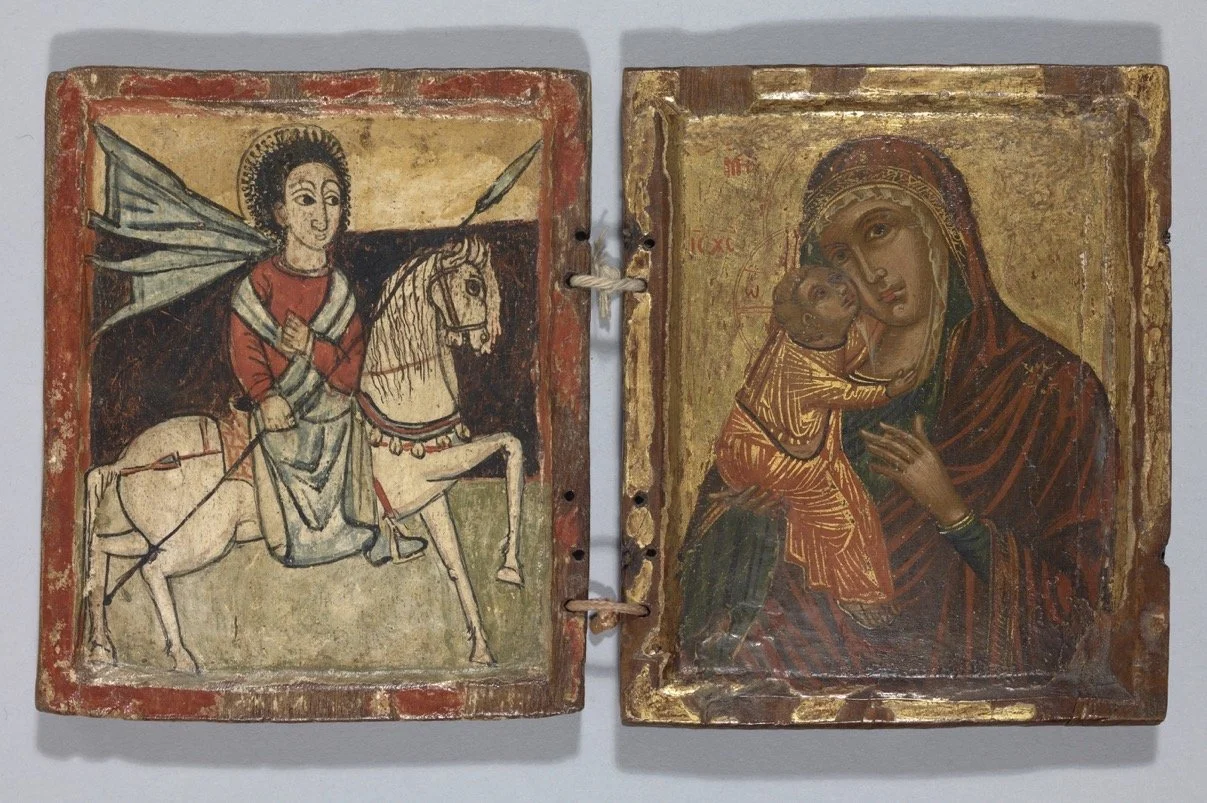
Diptych icon with Saint George and The Virgin and Child. Saint George wing: possibly Crete, ca. 1480–1490. Virgin and Child wing: Ethiopia, ca. 1500. Wyvern Collection, 0472.
Keynote Lecture by Lloyd de Beer (Curator at the British Museum): Friday April 10
Conference: Saturday April 11, 2026
followed by a reception at the Bowdoin College Museum of Art,
Featuring the exhibition, Medieval Art from the Wyvern Collection: Global Networks and Creative Connections
This interdisciplinary conference will explore new ways of understanding the chronological, geographic, and conceptual contours of the Middle Ages. In recent years, every discipline within the field of medieval studies has experienced what some have called the “global turn,” informed by emerging scholarship that has demonstrated the profoundly interconnected nature of the medieval world. We seek papers that engage with these new scholarly directions. We envision a set of panels with papers interrogating material including works of art, archaeological sites, literary and theological texts, and archival documents. The papers will be unified by a shared commitment to reckoning with our developing understanding of the global dimensions of medieval culture, presenting new sets of questions and new methods for understanding such objects.
We hope to receive proposals for papers from a range of disciplines and adopting a variety of approaches to questions such as:
to what extent is a concept of “the Middle Ages” useful in structuring our knowledge of past cultures, and to what extent does it occlude important aspects of the past?
Is that manner of periodization applicable to cultures beyond Europe, or does the application of such terminology to non-European contexts reinscribe upon those cultures Eurocentric or even colonial ways of seeing the world?
How do we balance an ability to comprehend the specific, often highly local roots of phenomena, texts, or objects with an awareness of the broader networks (trade, intellectual, etc.) that they participated in or engaged with?
Are there ways in which the “global turn” risks obscuring key aspects of medieval culture—for instance, moments in which a culture turns inward rather than reaching beyond itself, or the fragmentary and incomplete nature of apprehending something from a different place?
Are analytical tools such as “style,” developed in disciplines like Art History, capable of accounting for the ways that certain medieval objects were designed to legible across political and religious boundaries, or do those disciplinary tools need to be supplemented (or even supplanted) by different analytic approaches?
How did conceptions of a broader world on the part of authors and artisans shape the forms that cultural productions adopted?
Speakers in the conference will be provided with lodging for two nights (April 10 and 11) as well as meals during the conference; they are responsible for their own transportation costs.
Deadline for submissions: January 15, 2026.
Submit proposals to Steve Perkinson (Professor of Art History, Bowdoin College): sperkins@bowdoin.edu